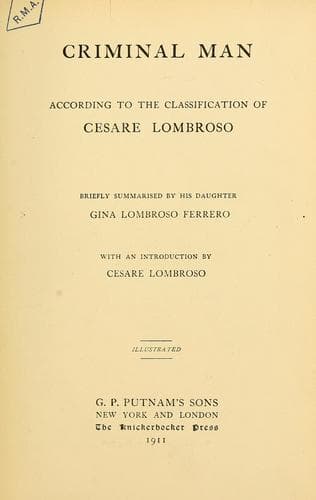
Criminal Man, According to the Classification of Cesare LombrosoLombroso, Gina
Science
Criminal Man, According to the Classification of Cesare Lombroso
Lombroso, Gina
Criminal anthropology; Criminology
Thus idiocy, epilepsy and genius, crimes and sublime deeds were forged
into one single chain; and the brilliant lights of some of its links,
and the gloomy shadows thrown by others, were reduced to a play of
molecules, like those which transform carbon into a refulgent diamond or
a sombre lump of graphite.
II
_Criminal Man (L'Uomo Delinquente) considered in relation to
Anthropology, Jurisprudence, and Psychiatry_
Although my father's theories on the male criminal have already been set
forth in the volume now presented to the public, I feel that it would
not be inappropriate to add to the descriptions of his other important
works a brief survey of the original book for the use of readers
desirous of studying the subject more thoroughly.
The first volume is devoted to an investigation of the atavistic origin
of crime among plants, animals, savages, and children. This is followed
by an exhaustive study of the physical nature of the born criminal and
the epileptic, modern craniology, the anomalies connected with the
different classes of offences, the spine, pelvis, limbs, and
physiognomy. The data given are based on the results obtained from the
examination of about 7000 criminals.
In the study of the brain, the macroscopic anomalies in the convolutions
and histological structure of the cerebral cortex of criminals and
epileptics are the object of special consideration, since these
anomalies solve the problem of the origin of criminality.
Certain additional degenerate characters, the prehensile foot, wrinkles,
lines on the finger-tips, the ethmoid-lachrymal suture, anomalies of
dentition, the existence of a single horizontal line on the palm of the
hand, etc., are further described, and a careful examination made of the
field of vision and olfactory and auditory sensibility.
The psychological examination of the criminal includes psychometry, the
discovery of new characteristics, such as neophily, lack of exactitude,
frequent existence of traits of genius, pictography, hieroglyphics,
gestures, and the arts and crafts peculiar to the criminal.
Finally, the different types of offenders--epileptic and morally insane
criminals, political and passionate offenders, inebriate, hysterical,
and mentally unbalanced (mattoid) criminals--are described separately
and compared with each other, their diversities and analogies being
thrown into relief. Around these types are grouped juridical figures of
crimes, reproduced from psychiatric forms. These are followed by an
examination of occasional or pseudo-criminals, criminaloids, latent
criminals, and geniuses.
Public-domain text, read in full here on John Shaqi.
Reviews
Reviews
No reviews yet
Be the first to share your thoughts on this work.
Elsewhere in the archive
Join the Discussion
Join the discussion
Sign in to leave a comment or review.
Sign InorCreate an account