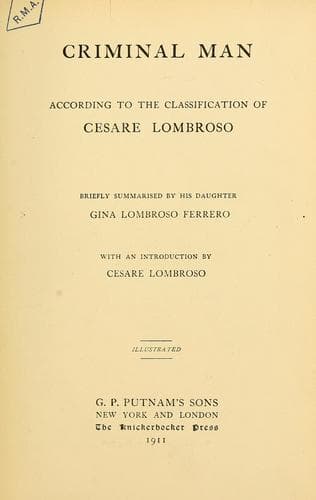
Criminal Man, According to the Classification of Cesare LombrosoLombroso, Gina
Science
Criminal Man, According to the Classification of Cesare Lombroso
Lombroso, Gina
Criminal anthropology; Criminology
The second volume treats of epileptics, and discusses, among other
things, their ergography, psychology, graphology, and anomalies of the
field of vision. The studies on criminals of passion are supplemented by
observations on suicides and political offenders, those on the insane
include investigations of their age, psychology, sex, tattooing,
heredity, and the difference between insane and ordinary criminals with
respect to the motives that prompt their crimes, and the manner in which
these are carried out, thus furnishing a new theory of sexual
psychopathy.
The third volume of the fifth edition treats of the etiology and cure of
crime.
In the part dealing with the etiology of crime, the geological,
ethnical, political, and economical factors determining or influencing
criminality, as well as other causes,--density of population, food,
alcoholism, sex, heredity, instruction, religion, etc., are examined
statistically and sifted with critical care. For the first time, light
is thrown on the influence exercised by criminality and wealth on the
increase or decrease of emigration.
My father demonstrates by means of data, contributed for the most part
by Bodio and Cognetti, that the importance attributed to poverty as a
factor of criminality, especially by certain socialistic schools, has
been largely exaggerated; while, at the same time, the fact that both
wealth and education have their specific crimes, has been ignored by
these schools.
In dealing with collective criminality, my father merely repeats the
original theories on the subject, expressed by him in 1872 and
constantly confirmed since then. These theories have been utilised and
illustrated by a number of writers: Ferri, Sighele, Ferrero, Le Bon, and
Tarde.
In the prophylaxis and cure of crime, not content with mere criticism of
present methods, the new doctrines suggest practical and efficacious
means of repressing crime.
In view of the fact that criminality is assuming a changed aspect,
adapted to the conditions of modern life and civilisation, it should be
combated by the very means furnished by progress,--the telegraph, press,
all measures for fighting alcoholism, popular places of recreation, etc.
Public-domain text, read in full here on John Shaqi.
Reviews
Reviews
No reviews yet
Be the first to share your thoughts on this work.
Elsewhere in the archive
Join the Discussion
Join the discussion
Sign in to leave a comment or review.
Sign InorCreate an account