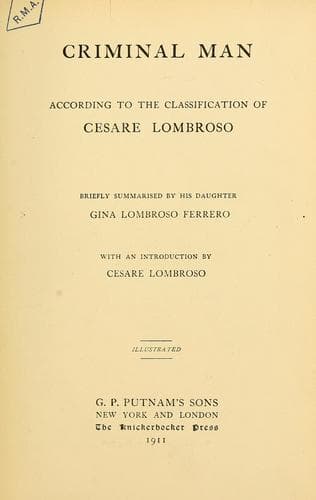
Criminal Man, According to the Classification of Cesare LombrosoLombroso, Gina
Science
Criminal Man, According to the Classification of Cesare Lombroso
Lombroso, Gina
Criminal anthropology; Criminology
In this book, which was written during the interval between the
publication of the new Penal Code and its sanction by the Italian
Parliament, my father makes a rapid criticism of the Code, which he
considered premature. Only a few decades had elapsed since the
proclamation of Italian Unity; and the widely differing races that
people the provinces constituting the kingdom of Italy had not been able
in that brief period to acquire sufficient uniformity of customs to make
a single code of laws desirable.
But the book is not merely a criticism. It also contains an exposition
of the fundamental principles that, according to my father, should
underlie every serious and efficacious code of laws. It is this part
that makes this somewhat hastily written book of such importance to
criminologists; because it sets forth under the chief heads the
juridical desiderata of the New School.
The following brief extract gives an indication of the nature of these
principles:
1. The legislation of a country should always be regulated by the
customs of the people whom it is to govern; and although a system of
different penal codes to suit the varying races and customs in the
different regions of one State may offer certain disadvantages, they are
always of less importance than the difficulties caused by a uniform
code.
2. The object of every code should be the attainment of social safety,
not the careful weighing of guilt and individual responsibility. The
worst and most dangerous criminals should be treated with the greatest
severity; but indulgence should be shown towards minor offenders. The
former should be segregated for life in prisons or asylums; the latter
should never be allowed to become acquainted with prison life, but
should be corrected by means of other penalties, which would not bring
them into contact with true criminals, nor necessitate their temporary
retirement from civil life.
3. Certain reprehensible actions (abortion, infanticide, suicide or
complicity therein, passionate crimes, duelling, swearing, adultery,
etc.), which are not considered criminal by the general public, should
be non-criminal in the eyes of the law.
4. Born criminals, the morally insane, and hopeless recidivists, whose
first convictions are not followed by any signs of improvement, should
be regarded as incurable and confined for life in criminal lunatic
asylums, relegated to penal colonies, or condemned to death.
A second edition of this book was published shortly afterwards with the
title _Notes on the New Penal Code_. In this edition, each of the most
notable adherents of the new doctrines: Ferri, Garofalo, Ballestrini,
Rossi, Masé Dari, Carelli, Caragnani, and others, discussed one special
point of the code and suggested the necessary modifications.
VI
_Prison Palimpsests_ (_I Palimsesti del Carcere_)
(A Collection of Prison Inscriptions for the Use of Criminologists)
Public-domain text, read in full here on John Shaqi.
Reviews
Reviews
No reviews yet
Be the first to share your thoughts on this work.
Elsewhere in the archive
Join the Discussion
Join the discussion
Sign in to leave a comment or review.
Sign InorCreate an account