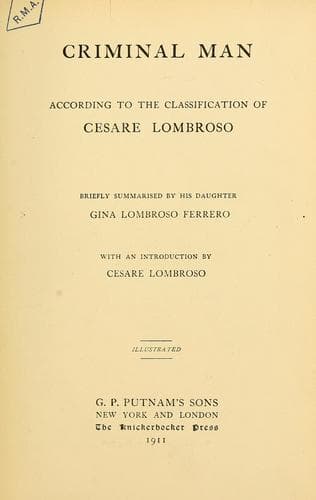
Criminal Man, According to the Classification of Cesare LombrosoLombroso, Gina
Science
Criminal Man, According to the Classification of Cesare Lombroso
Lombroso, Gina
Criminal anthropology; Criminology
"Ordinary individuals, and even scientific observers, are apt to regard
prisons, especially those in which the cellular system prevails, as mute
and paralytical organisms, deprived of speech and action, because
silence and immobility have been imposed on them by law. Since, however,
no decree, even when backed up by physical force, avails against the
nature of things, these organisms speak and act, and sometimes manifest
themselves in brutal assaults and murders; but as always happens when
human needs come into conflict with laws, all these manifestations are
made in hidden and subterranean ways. Walls, drinking-vessels, planks of
the prisoners' beds, margins of books, medicine wrappers, and even the
unstable sands of the exercise-grounds, and the uniform in which the
prisoner is garbed, supply him with a surface on which to imprint his
thoughts and feelings."
With this paragraph my father begins the introduction to his book
_Prison Palimpsests_, a collection of inscriptions and documents
revealing the inmost thoughts of prisoners.
In the first part, these inscriptions are classified under different
headings: opinions on prison life, penalties, morality, women, etc., and
according to the surface on which they are inscribed--books, walls,
pitchers, clothing, paper, etc.
For the psychologist and the student of degenerate types of humanity,
this collection is of the greatest interest. The inscriptions are
followed by a series of poems, autobiographies, and letters written by
intending suicides, and criminals immediately before their execution.
The comments made by criminals on the margins of books belonging to the
prison library are especially interesting, because they enable the
student to compare the effect produced on criminals by certain works
with the impressions of normal individuals. The poems written by
prisoners are equally interesting, since, like popular songs, they
represent the intimate expression of the poet's desires and aspirations.
In the second part, these prison inscriptions are compared with the
remarks commonly found scribbled in the streets, on school benches, and
on the walls of public buildings of all kinds--courts of justice, places
of worship, and even those edifices in which the legislation of the
State is framed. All the inscriptions are classified according to the
sentiments they express and the sex of the writer, distinction being
made between the writings of prisoners and those of the ordinary public.
The book closes with practical suggestions regarding the use to which
similar collections might be put, as critical hints on the present
methods of dealing with criminals and as an aid in investigating the
characters of accused persons.
Public-domain text, read in full here on John Shaqi.
Reviews
Reviews
No reviews yet
Be the first to share your thoughts on this work.
Elsewhere in the archive
Join the Discussion
Join the discussion
Sign in to leave a comment or review.
Sign InorCreate an account