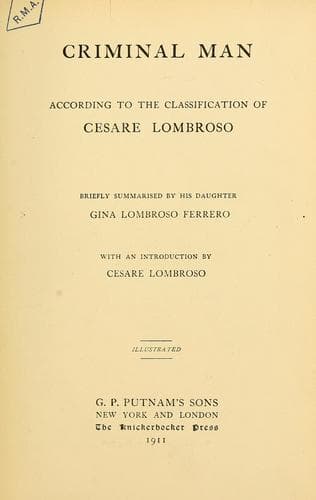
Criminal Man, According to the Classification of Cesare LombrosoLombroso, Gina
Science
Criminal Man, According to the Classification of Cesare Lombroso
Lombroso, Gina
Criminal anthropology; Criminology
Such being the origin, and such the promoters of anarchism, it is
evident that the methods for curing crimes deriving from this source
should differ greatly from those used in suppressing ordinary crime.
In spite of the fact that anarchists are frequently criminals, their
ideas, although often absurd, imply a greater elevation of character
than the cynical apathy in which the worst types of criminals are sunk.
Instead of combating violence by violence and dealing out death
sentences with a prodigality almost rivalling that of anarchists
themselves, the authorities should segregate the most dangerous types or
relegate them to distant islands, and adopt exile as a penalty for
genuine criminals of passion. However, political liberty and some
safety-valve, whereby lawless instincts may be turned into harmless
channels, are the best methods for preventing anarchism. Constitutional
government and freedom of speech and the press may go a long way towards
combating anarchism; but the restoration of popular tribunates, like
those to which Rome owed her balance and tranquillity, would be still
more efficacious. If the governing bodies were to favour, instead of
hindering, the formation of such institutions, which tend to spring up
everywhere and to voice the grievances of the people, just causes would
not be abandoned exclusively to the advocacy of extremists.
X
_Lectures on Legal Medicine_ (_Lezioni di Medicina Legale_)
This book, as the preface explains, was an attempt to present in a
concise and popular form the theories of criminal anthropologists, on
which the author had previously delivered a series of university
lectures, and which he feared might have been erroneously or imperfectly
understood by those of his hearers who were diffident or insufficiently
prepared.
It is divided into three parts, criminal anthropology, mental
alienation, and the relation of serious offences (assault, murder,
poisoning, etc.) to legal medicine.
The first part contains a summing-up of the author's ideas on the
atavistic and pathological origin of the criminal. He examines the
equivalents of crime among plants, animals, savages, and children,
describes the pathological causes which call forth atavistic instincts
and alludes to other special kinds of degeneration peculiar to
criminals. Finally, the anatomy, functions, and internal organs of the
criminal are examined, and a careful study made of his intellectual
manifestations and psychology. Similar studies on epileptics and the
morally insane show that the three forms are only variations of the same
degeneration.
Public-domain text, read in full here on John Shaqi.
Reviews
Reviews
No reviews yet
Be the first to share your thoughts on this work.
Elsewhere in the archive
Join the Discussion
Join the discussion
Sign in to leave a comment or review.
Sign InorCreate an account