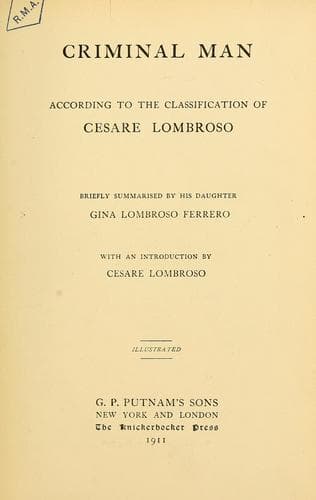
Criminal Man, According to the Classification of Cesare LombrosoLombroso, Gina
Science
Criminal Man, According to the Classification of Cesare Lombroso
Lombroso, Gina
Criminal anthropology; Criminology
The Appendix contains studies on the application of mental tests in
medico-legal practice, and a glossary, alphabetically arranged, of the
terms commonly employed in criminal anthropology, compiled by Dr.
Legiardi-Laura.
IX
_Anarchists_ (_Gli Anarchici_)
The book opens with an examination of the theories of anarchists, from
which the author arrives at the conclusion that in view of the
importance generally conceded to economic ideals to-day and the
universal abuse of power, these theories in reality are not so absurd as
they are supposed to be. It is the methods adopted by anarchists for the
realisation of their ideals that are both absurd and dangerous.
"However valuable many of the proposals of anarchism may be," says the
author, "they become absurd in practice; because all reforms should be
introduced very gradually in order to escape the inevitable reaction
which neutralises all previous efforts."
The crimes of anarchists tend to mingle with ordinary crimes when
certain dreamers attempt to reach their goal by any means
possible--theft, or the murder of a few, often innocent, persons. It is
easy to realise, therefore, why, with a few exceptions, anarchists are
recruited from among ordinary criminals, lunatics, and insane criminals.
Investigations made by the author showed that 12 per cent. of the
communards were of a criminal type, and this percentage was still higher
in anarchists (31 per cent.). Of forty-five anarchists examined at
Chicago, 40 per cent. had faces of a criminal cast. The majority of
anarchists possess the passions and vices peculiar to ordinary
criminals: impulsiveness, love of orgies, lack of natural affections and
moral sense; and similar intellectual manifestations, such as slang,
ballads, tattooing, hieroglyphics. But there are a greater number of
genuine epileptic and hysterical subjects, lunatics, and indirect
suicides among anarchists than among ordinary criminals; greater, too,
is the proportion of criminals from passion. These truly heroic
natures, profoundly convinced that the remedy for so many social evils
lies in the murder of certain personages of high standing, who appear to
bear the greatest share of responsibility for the existing system, do
not hesitate to have recourse to violence when they deem it necessary;
although it is distasteful to them and although they have hitherto
disassociated themselves from the excesses of their companions. The
anarchists Caserio and Bresci were of this type. The crimes of these
passionate criminals are always accomplished single-handed; they always
surrender to the police immediately afterwards and make no attempt to
defend themselves. On the contrary, when in court, they frequently give
a lucid explanation of the motives that have induced them to commit
their crimes and affront the penalty with stoicism.
Public-domain text, read in full here on John Shaqi.
Reviews
Reviews
No reviews yet
Be the first to share your thoughts on this work.
Elsewhere in the archive
Join the Discussion
Join the discussion
Sign in to leave a comment or review.
Sign InorCreate an account