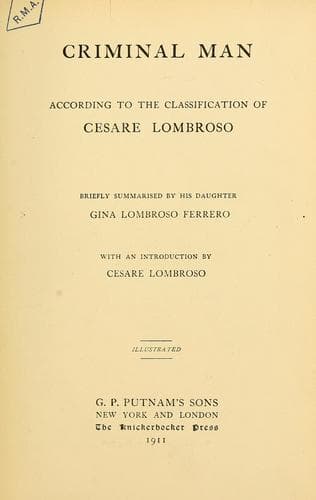
Criminal Man, According to the Classification of Cesare LombrosoLombroso, Gina
Science
Criminal Man, According to the Classification of Cesare Lombroso
Lombroso, Gina
Criminal anthropology; Criminology
Polymastia, or the presence of supernumerary nipples (which are
generally placed symmetrically below the normal ones as in many mammals)
is not an uncommon anomaly. Gynecomastia or hypertrophy of the mammæ is
still more frequent in male criminals. In female criminals, on the
contrary, we often find imperfect development or absence of the
nipples, a characteristic of monotremata or lowest order of the mammals;
or the breasts are flabby and pendent like those of Hottentot women.
The chest is often covered with hair which gives the subject the
appearance of an animal.
_The Pelvis and Abdomen._ The abdomen, pelvis, and reproductive organs
sometimes show an inversion of sex-characters. In 42% the sacral canal
is uncovered, and in some cases there is a prolongation of the coccyx,
which resembles the stump of a tail, sometimes tufted with hair.
_The Upper Limbs._ One of the most striking and frequent anomalies
exhibited by criminals is the excessive length of the arms as compared
with the lower limbs, owing to which the span of the arms exceeds the
total height, an ape-like character.
Six per cent. exhibit an anomaly which is extremely rare among normal
individuals--the olecranon foramen, a perforation in the head of the
humerus where it articulates with the ulna. This is normal in the ape
and dog and is frequently found in the bones of prehistoric man and in
some of the existing inferior races of mankind.
Several abnormal characters, which point to an atavistic origin, are
found in the palm and fingers. Supernumerary fingers (polydactylism) or
a reduction in the usual number are not uncommon. Sometimes we find
syndactylism, or palmate fingers, a continuation of the interdigital
skin to the second phalanx. The length of the fingers varies according
to the type of crime to which the individual is addicted. Those guilty
of crimes against the person have short, clumsy fingers and especially
short thumbs. Long fingers are common to swindlers, thieves, sexual
offenders, and pickpockets. The lines on the palmar surfaces of the
finger-tips are often of a simple nature as in the anthropoids. The
principal lines on the palm are of special significance. Normal persons
possess three, two horizontal and one vertical, but in criminals these
lines are often reduced to one or two of horizontal or transverse
direction, as in apes.
_The Lower Limbs._ Of a number of criminals examined, 16% showed an
unusual development of the third trochanter, a protuberance on the head
of the femur where it articulates with the pelvis. This distinctly
atavistic character is connected with the position of the hind-limb in
quadrupeds.
Public-domain text, read in full here on John Shaqi.
Reviews
Reviews
No reviews yet
Be the first to share your thoughts on this work.
Join the Discussion
Join the discussion
Sign in to leave a comment or review.
Sign InorCreate an account