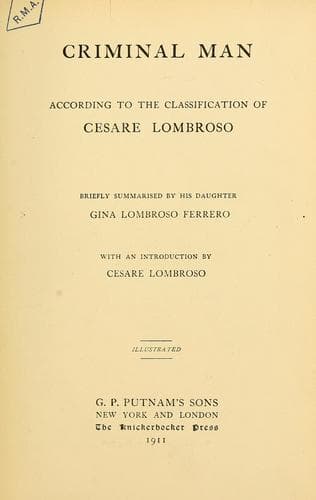
Criminal Man, According to the Classification of Cesare Lombroso — John Shaqi
Criminal Man, According to the Classification of Cesare LombrosoLombroso, Gina
Science
Criminal Man, According to the Classification of Cesare Lombroso
Lombroso, Gina
Criminal anthropology; Criminology
The ability to discriminate between right and wrong, which is the
highest attribute of civilised humanity, is notably lacking in
physically and psychically stunted organisms. Many criminals do not
realise the immorality of their actions. In French criminal jargon
conscience is called "la muette," the thief "l'ami," and "travailler"
and "servir" signify to steal. A Milanese thief once remarked to my
father: "I don't steal. I only relieve the rich of their superfluous
wealth." Lacenaire, speaking of his accomplice Avril, remarked, "I
realised at once that we should be able to work together." A thief asked
by Ferri what he did when he found the purse stolen by him contained no
money, replied, "I call them rogues." The notions of right and wrong
appear to be completely inverted in such minds. They seem to think they
have a right to rob and murder and that those who hinder them are
acting unfairly. Murderers, especially when actuated by motives of
revenge, consider their actions righteous in the extreme.
_Repentance and Remorse._ We hear a great deal about the remorse of
criminals, but those who come into contact with these degenerates
realise that they are rarely, if ever, tormented by such feelings. Very
few confess their crimes: the greater number deny all guilt in a most
strenuous manner and are fond of protesting that they are victims of
injustice, calumny, and jealousy. As Despine once remarked with much
insight, nothing resembles the sleep of the just more closely than the
slumbers of an assassin.
Many criminals, indeed, allege repentance, but generally from
hypocritical motives; either because they hope to gain some advantage by
working on the feelings of philanthropists, or with a view to escaping,
or, at any rate, improving their condition while in prison. Thus
Lacenaire, when convicted for the first time, wrote in a moving strain
to his friend Vigouroux in order to get money and help from him,
"Repentance is the only course left open to me. You may well feel
pleased at having turned a man from a path of crime for which he was not
intended by nature." A few hours later he committed another theft, and
before he died remarked cynically that he had never experienced
remorse. When tried at the Assizes at Pavia, Rognoni pronounced a
touching discourse on his repentance and refused the wine brought him in
prison for some days because it reminded him of his murdered brother.
But he obtained it surreptitiously from his fellow-prisoners, and when
one of them grumbled at having to give up his own portion, Rognoni
threatened him saying, "I have already murdered four, and shall make no
bones about killing a fifth."
Sometimes remorse is advanced by criminals as a palliation of their
crimes. Michelieu justified the _coup de grace_ inflicted on his victim
by saying, "When I saw her in that state, I felt such terrible remorse
that I shot her dead in order not to meet her glance."
Public-domain text, read in full here on John Shaqi.
Reviews
Reviews
No reviews yet
Be the first to share your thoughts on this work.
Join the Discussion
Join the discussion
Sign in to leave a comment or review.
Sign InorCreate an account