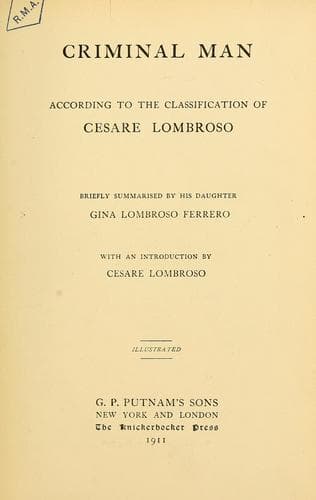
Criminal Man, According to the Classification of Cesare LombrosoLombroso, Gina
Science
Criminal Man, According to the Classification of Cesare Lombroso
Lombroso, Gina
Criminal anthropology; Criminology
_Social Position and Culture of the Criminaloid._ Criminaloids, as we
have seen, are recruited from all ranks of society and strike every note
in the scale of criminality, from petty larceny to complicated and
premeditated murder, from minting spurious coins to compassing gigantic
frauds, which inflict incalculable damage upon the community. The
magnitude of a crime does not imply greater criminality on the part of
its author, but rather that he is a man of brilliant endowments, whose
culture and talents multiply his opportunities and means for evil. In
all cases where opportunity plays an important part, the crime must
necessarily be committed by individuals exposed to special temptations:
cashiers who handle other people's money, which they may be tempted to
spend with the illusory idea of being able later to replace what they
have taken, officials and public men, who possess a certain amount of
power and an apparent impunity, and bankers who are entrusted with
wealth belonging to others, of which in that capacity they are
accustomed to make use. Thus is explained why men of great talent and
only slight criminal tendencies have taken part in gigantic frauds, such
as the affairs of the Bank of Rome and the French Panama Canal.
A characteristic case is that of Lord S----, First Lord of the Treasury,
who committed forgeries to the extent of half a million sterling. "No
torture," he writes, "would be an adequate punishment for my crime. Step
by step, I have become the author of innumerable misdeeds and ruined
more than ten thousand families. With less talent and greater
uprightness, I might be now what I once was, an honest man. Now remorse
is in vain."
In Lord S---- we find united all the characteristics of the criminaloid:
repentance, the desire to confess, irreproachable antecedents, a strong
incentive to dishonesty, and great intelligence.
Although the damage inflicted on society by this man was probably far
greater than any evil wrought by a vulgar born criminal could have been,
his criminality is nevertheless of an attenuated type. The mischief he
wrought owed its gravity, not to the intensity of his criminal
tendencies, but to his remarkable talents, which increased his power for
evil as for good.
In this category of criminals must be inscribed those clever swindlers,
who set the whole world talking of their exploits: Madame Humbert,
Lemoine, and the cobbler-captain of Köpenick.
Public-domain text, read in full here on John Shaqi.
Reviews
Reviews
No reviews yet
Be the first to share your thoughts on this work.
Elsewhere in the archive
Join the Discussion
Join the discussion
Sign in to leave a comment or review.
Sign InorCreate an account