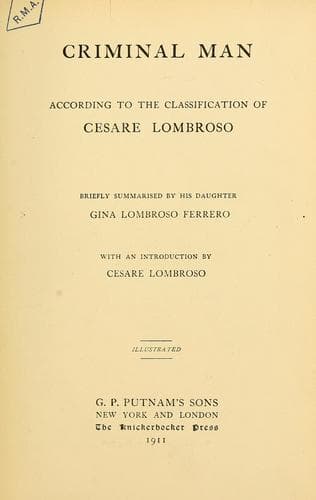
Criminal Man, According to the Classification of Cesare LombrosoLombroso, Gina
Science
Criminal Man, According to the Classification of Cesare Lombroso
Lombroso, Gina
Criminal anthropology; Criminology
Sometimes, especially in political or commercial criminals, we find
cases of an auto-illusion, of which the author of the crime is as much
a victim as the public. Sometimes it is some device or mechanism which
an inventor is convinced he has invented or is about to invent, an
enterprise, in which the promoter imagines he will gain enormous wealth.
Sometimes it is a trick in which the cupidity of the victims and their
readiness to swallow promises of large and immediate profits play as
important a part as the ability of the swindler. Sometimes it is a
gigantic hoax, in which the deviser himself becomes keenly interested
and for the carrying out of which he spends as much talent and energy as
would suffice, if employed honestly, to acquire considerable wealth; but
the swindler delights in his ingenious fraud as though he were taking
part in some thrilling drama.
A typical instance is that of a certain C... who was imprisoned about
twenty years ago for defrauding a woman. My father undertook to cure him
while in prison and was able to follow him in his subsequent career.
This C... was a young man of good family, intelligent, honest, and a
good linguist. His countenance was pleasing and bore no trace of
precocious criminality. At the age of twenty he developed an
unrestrained love of gambling and in order to indulge this vice,
promised to marry a rich woman considerably older than himself, from
whom he borrowed large sums, on the understanding that they should be
paid back. However, shortly afterwards, he fell in love with a young
girl and married her. His ex-fiancée brought legal action against him
and he was sentenced to two years' imprisonment. During this time he
shrank from seeing anybody and refused to exercise in order to avoid all
contact with his fellow-prisoners. He showed great affection for his
wife and declared his intention of turning over a new leaf. The offence
he had committed, however seemed to cause him little or no regret,
because, as he said, he would never have continued the deception had not
his victim shown such willingness to be gulled. From prison he went to
London, where lack of funds caused him to perpetrate another swindle,
but this time he was able to escape to Naples. Here for twelve years, he
worked honestly in a large hotel, but once again a pressing need of
money made him engage in a third fraud of considerable importance, for
which he is still undergoing imprisonment.
HABITUAL CRIMINALS
The degrading influence of prison life and contact with vulgar
criminals, or the abuse of alcohol, to which better natures frequently
have recourse in order to stifle the pangs of conscience, may cause
criminaloids who have committed their initial offences with repugnance
and hesitation, to develop later into habitual criminals,--that is,
individuals who regard systematic violation of the law in the light of
an ordinary trade or occupation and commit their offences with
indifference.
Public-domain text, read in full here on John Shaqi.
Reviews
Reviews
No reviews yet
Be the first to share your thoughts on this work.
Elsewhere in the archive
Join the Discussion
Join the discussion
Sign in to leave a comment or review.
Sign InorCreate an account