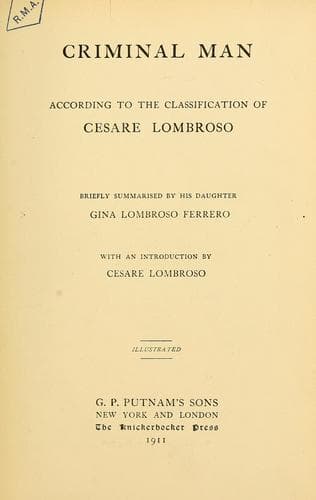
Criminal Man, According to the Classification of Cesare LombrosoLombroso, Gina
Science
Criminal Man, According to the Classification of Cesare Lombroso
Lombroso, Gina
Criminal anthropology; Criminology
Among the _Nairs_, a noble negro caste of Malabar, it is customary for
one woman to have five or six husbands, the maximum number allowed
being ten.
In Egypt, the business of thief was a recognised one. Those who wished
to exercise this calling inscribed their names on a public tablet,
collected all the stolen goods in one spot and restored them to their
owners in exchange for a certain coin. The ancient Germans encouraged
the youthful portion of the population to make raids on the property of
neighbouring peoples, so that they should not develop habits of
idleness. Thucydides states that the Greeks, as well as the barbarous
peoples inhabiting the islands and along the coasts, were pirates, and
the calling was a noble one.
Amongst Spartans, as is well known, theft was allowed, but the unlucky
marauder who was caught in the act, was punished, not for the deed
itself, but for his want of skill. In East Africa, according to Burton
(_First Footsteps in East Africa_, p. 176), robbery is considered
honourable. In Caramanza (Portuguese Guinea) in Africa, side by side
with the peaceful rice-cultivating Bagnous dwell the Balantes who
subsist upon the chase and the spoils of their raids. While they kill
the individual who presumes to steal in his native village, they
encourage depredations upon the other tribes (_Revue d' Anthropologie_,
1874). The cleverest thieves are greatly esteemed, are paid for
instructing boys in their profession, and are chosen to lead the
expeditions.
In India the tribe Zakka Khel is devoted to this dishonest calling, and
at birth every male child is consecrated to thievish practices by a
peculiar ceremony, in which the new-born infant is passed through a
breach in the wall of his father's house, whilst the words "Become a
thief" are chanted three times in chorus. Amongst the ancient Germans,
according to Tacitus, thefts perpetrated outside the boundary of the
tribe itself were by no means infamous. In the midst of a great
assembly, the chief called upon those he wished to follow him; they
showed their willingness by rising to their feet amid the applause of
the crowd. Those who refused to take part were looked upon as deserters
and traitors (Spencer, _Principles of Ethics_, 1895). Among the
Comanches (Mülhausen, _Diary of a Journey from the Mississippi to the
Pacific_) no man was considered worthy of being numbered among the
warriors of the tribe, unless he had taken part in some successful
pillaging expedition. The cleverest thieves were the most respected
members of the tribe. No Patagonian is deemed worthy of a wife unless he
has graduated in the art of despoiling a stranger (Snow, _Two Years'
Cruise round Tierra del Fuego_). Among the Kukis (Dalton, _Descriptive
Ethnology of Bengal_) skill in stealing is the most esteemed talent. In
Mongolia (Gilmour, _Among the Mongols_), thieves are regarded as
respectable members of the community, provided they steal cleverly and
escape detection.
CRIMINALITY IN CHILDREN
Public-domain text, read in full here on John Shaqi.
Reviews
Reviews
No reviews yet
Be the first to share your thoughts on this work.
Elsewhere in the archive
Join the Discussion
Join the discussion
Sign in to leave a comment or review.
Sign InorCreate an account