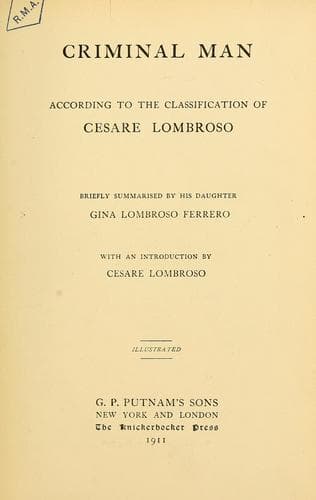
Criminal Man, According to the Classification of Cesare LombrosoLombroso, Gina
Science
Criminal Man, According to the Classification of Cesare Lombroso
Lombroso, Gina
Criminal anthropology; Criminology
The criminal instincts common to primitive savages would be found
proportionally in nearly all children, if they were not influenced by
moral training and example. This does not mean that without educative
restraints, all children would develop into criminals. According to the
observations made by Prof. Mario Carrara at Cagliari, the bands of
neglected children who run wild in the streets of the Sardinian capital
and are addicted to thievish practices and more serious vices,
spontaneously correct themselves of these habits as soon as they have
arrived at puberty.
This fact, that the germs of moral insanity and criminality are found
normally in mankind in the first stages of his existence, in the same
way as forms considered monstrous when exhibited by adults, frequently
exist in the foetus, is such a simple and common phenomenon that it
eluded notice until it was demonstrated clearly by observers like
Moreau, Perez, and Bain. The child, like certain adults, whose
abnormality consists in a lack of moral sense, represents what is known
to alienists as a morally insane being and to criminologists as a born
criminal, and it certainly resembles these types in its impetuous
violence.
Perez (_Psychologie de l'enfant_, 2d ed., 1882) remarks on the frequency
and precocity of anger in children:
"During the first two months, it manifests by movements of the
eyebrows and hands undoubted fits of temper when undergoing any
distasteful process, such as washing or when deprived of any object
it takes a fancy to. At the age of one, it goes to the length of
striking those who incur its displeasure, of breaking plates or
throwing them at persons it dislikes, exactly like savages."
Moreau (_De l'Homicide chez les enfants_, 1882) cites numerous cases of
children who fly into a passion if their wishes are not complied with
immediately. In one instance observed by him a very intelligent child of
eight, when reproved, even in the mildest manner by his parents or
strangers, would give way to violent anger, snatching up the nearest
weapon, or if he found himself unable to take revenge, would break
anything he could lay his hands on.
A baby girl showed an extremely violent temper, but became of gentle
disposition after she had reached the age of two (Perez). Another,
observed by the same author, when only eleven months old, flew into a
towering rage, because she was unable to pull off her grandfather's
nose. Yet another, at the age of two, tried to bite another child who
had a doll like her own, and she was so much affected by her anger that
she was ill for three days afterwards.
Nino Bixio, when a boy of seven (_Vita_, Guerzoni, 1880) on seeing his
teacher laugh because he had written his exercise on office
letter-paper, threw the inkstand at the man's face. This boy was
literally the terror of the school, on account of the violence he
displayed at the slightest offence.
Public-domain text, read in full here on John Shaqi.
Reviews
Reviews
No reviews yet
Be the first to share your thoughts on this work.
Elsewhere in the archive
Join the Discussion
Join the discussion
Sign in to leave a comment or review.
Sign InorCreate an account