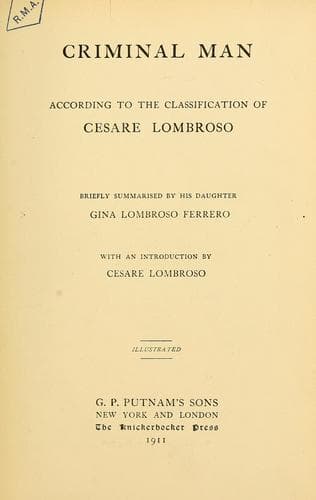
Criminal Man, According to the Classification of Cesare LombrosoLombroso, Gina
Science
Criminal Man, According to the Classification of Cesare Lombroso
Lombroso, Gina
Criminal anthropology; Criminology
I was present at the hearing of a case against a lad, who was accused of
having travelled on a subway without paying. He was sentenced to copy
out the by-laws twenty times, to learn them by heart and repeat them a
month later at the same court. In the case of more serious offences,
children may be sent to some public or private reformatory, according to
the circumstances of the parents. However, none of these punishments are
infamous, and parents themselves, when unable to control their children,
have recourse to the juvenile court.
It is supplemented in a very efficacious manner by the probation system,
the organisation of a number of men and women who undertake the
supervision of children when the court decides that they require it.
These protectors use every means at their disposal to prevent their
charges falling into bad ways and assist them in every possible way to
correct their defects.
This system has proved to be so efficacious, and at the same time so
devoid of any drawbacks, that its unconditional adoption by all the
States of Europe and America would be of great social advantage.
INSTITUTIONS FOR FEMALE OFFENDERS
The weighty reasons which call for separate courts and reformatories for
juvenile offenders are equally valid in the case of female law-breakers,
for whom special tribunals and legislation should be provided.
The percentage of criminality among women is considerably lower than
that of men, and in nearly all cases offenders belong to the category of
criminaloids.
My father's work _The Female Offender_ demonstrates that prostitution is
the true equivalent of criminality. When we except this class of
unfortunates, there remain only hysterical and occasional offenders,
guilty generally of petty larceny (particularly of a domestic nature) or
of harbouring criminals and acting as more or less passive accomplices;
and criminals from passion, who commit infanticide or kill faithless
husbands and lovers. In all these cases, imprisonment should not be
resorted to; in fact, the greater number might be dealt with by a
magisterial reprimand or the granting of conditional liberty. In view
also, of the important part played by dress, ornaments, etc., in the
feminine world, penalties inflicted on vanity--the cutting off of the
hair, the obligation to wear a certain costume, etc., might with
advantage be substituted for imprisonment.
The milder nature of feminine criminality, the usefulness of women in
the home, and the serious injury inflicted on the family and society in
general by the segregation of the wife and mother (if only for a short
period), are reasons for advocating the institution of special tribunals
for dealing with the offences of women and special legislation which
would take into consideration their position in the family and the fact
that they are rarely a violent social danger.
Public-domain text, read in full here on John Shaqi.
Reviews
Reviews
No reviews yet
Be the first to share your thoughts on this work.
Elsewhere in the archive
Join the Discussion
Join the discussion
Sign in to leave a comment or review.
Sign InorCreate an account