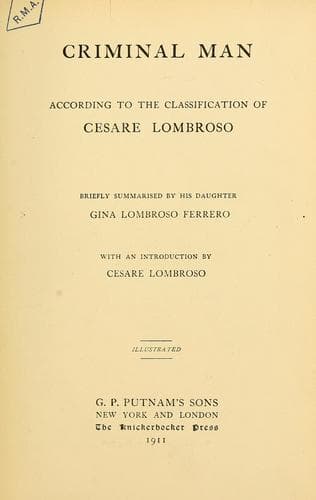
Criminal Man, According to the Classification of Cesare LombrosoLombroso, Gina
Science
Criminal Man, According to the Classification of Cesare Lombroso
Lombroso, Gina
Criminal anthropology; Criminology
At present, in Europe at least, no such differential treatment exists.
The reduction of penalties is left entirely to the discretion and
humanity of judges, who in many cases, it is true, are instinctively
disposed to be more indulgent towards women and to take these
conditions into account. But it would be a far more satisfactory state
of things if legislation paid due regard to such circumstances, just as
in Italy in enrolling recruits for compulsory military service,
allowance is made for social and family relations, the only sons of
widowed mothers, men of delicate constitution, etc., being exempted.
In spite of the low percentage and, generally speaking, trifling
importance of the crimes committed by women, there are a small number of
female delinquents, some of whom show an extraordinary degree of
depravity, as though all the perversity lacking in the others were
concentrated in these few. They are true born criminals, epileptics, and
morally insane subjects.
These serious anti-social elements, murderers, poisoners, and swindlers,
might be secluded in a small reformatory with compulsory labour and
silence as additional penalties. Separate cells, however, are not
necessary. All reformatories for women should be provided with a nursery
where children born in prison could be nursed by their mothers, thereby
diminishing the social injury which must result from the imprisonment of
any mother, and fostering the growth of the sublime and sacred maternal
sentiment, which is unfortunately so often lacking in criminals.
The Reformatory Prison for Women at South Framingham, near Boston, under
the management of Mrs. Morton, is an excellent example of an institution
conducted on the lines laid down by criminologists. The Reformatory is
situated at about an hour's journey by rail from Boston, in the midst of
fields which are cultivated by a part of the convict population. No high
walls surround the building and separate it from the outer world, nor is
it watched by guards. A broad avenue leads to the entrance, where, in
answer to my ring, I was welcomed by neat white-clad attendants and
shown into a charming room looking out upon a lovely garden. I passed
through corridors, unmolested by the sound of keys grating in locks,
from this room to the dining-rooms, dormitories, recreation and work
rooms.
As soon as prisoners enter the Reformatory, they are carefully examined
by an intelligent and pleasant woman physician, who is in charge of the
infirmary where the anthropological examination takes place. When the
prisoner has been declared able-bodied, she is placed in one of the
work-rooms to learn and follow the trade indicated by the medical
officer as the best adapted to her constitution and aptitude. At night,
she is conducted to a second-class cell situated in a large,
well-lighted corridor. The cell is furnished with a table, bed, chair,
pegs to hang clothes on, a calendar, a picture, and a book or two.
Public-domain text, read in full here on John Shaqi.
Reviews
Reviews
No reviews yet
Be the first to share your thoughts on this work.
Elsewhere in the archive
Join the Discussion
Join the discussion
Sign in to leave a comment or review.
Sign InorCreate an account