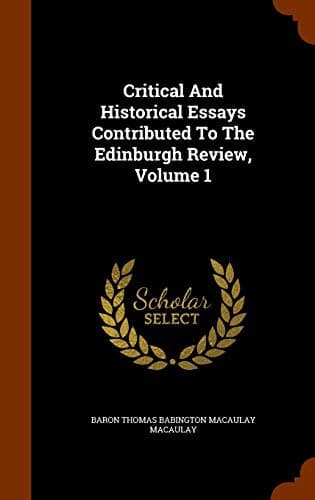
Critical and Historical Essays — Volume 1Macaulay, Thomas Babington Macaulay, Baron
History
Critical and Historical Essays — Volume 1
Macaulay, Thomas Babington Macaulay, Baron
English literature -- History and criticism; Great Britain -- History
One of Sir William’s pieces, however, deserves notice, not, indeed, on
account of its intrinsic merit, but on account of the light which it
throws on some curious weaknesses of his character, and on account of
the extraordinary effects which it produced in the republic of letters.
A most idle and contemptible controversy had arisen in France touching
the comparative merit of the ancient and modern writers. It was
certainly not to be expected that, in that age, the question would be
tried according to those large and philosophical principles of criticism
which guided the judgments of Lessing and of Herder. But it might have
been expected that those who undertook to decide the point would at
least take the trouble to read and understand the authors on whose
merits they were to pronounce. Now, it is no exaggeration to say that,
among the disputants who clamoured, some for the ancients and some for
the moderns, very few were decently acquainted with either ancient or
modern literature, and hardly one was well acquainted with both. In
Racine’s amusing preface to the Iphigenie the reader may have noticed a
most ridiculous mistake into which one of the champions of the moderns
fell about a passage in the Alcestis of Euripides. Another writer is
so inconceivably ignorant as to blame Homer for mixing the four Greek
dialects, Doric, Ionic, Aeolic, and Attic, just, says he, as if a French
poet were to put Gascon phrases and Picard phrases into the midst of his
pure Parisian writing. On the other hand, it is no exaggeration to say
that the defenders of the ancients were entirely unacquainted with the
greatest productions of later times; nor, indeed, were the defenders of
the moderns better informed. The parallels which were instituted in the
course of this dispute are inexpressibly ridiculous. Balzac was selected
as the rival of Cicero. Corneille was said to unite the merits of
Aeschylus, Sophocles, and Euripides. We should like to see a Prometheus
after Corneille’s fashion. The Provincial Letters, masterpieces
undoubtedly of reasoning, wit, and eloquence, were pronounced to be
superior to all the writings of Plato, Cicero, and Lucian together,
particularly in the art of dialogue, an art in which, as it happens,
Plato far excelled all men, and in which Pascal, great and admirable in
other respects, is notoriously very deficient.
Public-domain text, read in full here on John Shaqi.
Reviews
Reviews
No reviews yet
Be the first to share your thoughts on this work.
Elsewhere in the archive
Join the Discussion
Join the discussion
Sign in to leave a comment or review.
Sign InorCreate an account