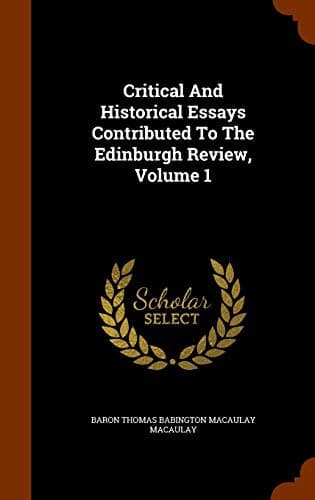
Critical and Historical Essays — Volume 1Macaulay, Thomas Babington Macaulay, Baron
History
Critical and Historical Essays — Volume 1
Macaulay, Thomas Babington Macaulay, Baron
English literature -- History and criticism; Great Britain -- History
There have always been monarchies in Asia, in which the royal authority
has been tempered by fundamental laws, though no legislative body exists
to watch over them. The guarantee is the opinion of a community of
which every individual is a soldier. Thus, the king of Cabul, as Mr.
Elphinstone informs us, cannot augment the land revenue, or interfere
with the jurisdiction of the ordinary tribunals.
In the European kingdoms of this description there were representative
assemblies. But it was not necessary that those assemblies should meet
very frequently, that they should interfere with all the operations
of the executive government, that they should watch with jealousy, and
resent with prompt indignation, every violation of the laws which the
sovereign might commit. They were so strong that they might safely be
careless. He was so feeble that he might safely be suffered to encroach.
If he ventured too far, chastisement and ruin were at hand. In fact,
the people generally suffered more from his weakness than from his
authority. The tyranny of wealthy and powerful subjects was the
characteristic evil of the times. The royal prerogatives were not even
sufficient for the defence of property and the maintenance of police.
The progress of civilisation introduced a great change. War became a
science, and, as a necessary consequence, a trade. The great body of the
people grew every day more reluctant to undergo the inconveniences of
military service, and better able to pay others for undergoing them.
A new class of men, therefore, dependent on the Crown alone, natural
enemies of those popular rights which are to them as the dew to the
fleece of Gideon, slaves among freemen, freemen among slaves, grew into
importance. That physical force which in the dark ages had belonged to
the nobles and the commons, and had, far more than any charter, or any
assembly, been the safeguard of their privileges, was transferred
entire to the King. Monarchy gained in two ways. The sovereign was
strengthened, the subjects weakened. The great mass of the population,
destitute of all military discipline and organisation, ceased to
exercise any influence by force on political transactions. There have,
indeed, during the last hundred and fifty years, been many popular
insurrections in Europe: but all have failed except those in which the
regular army has been induced to join the disaffected.
Public-domain text, read in full here on John Shaqi.
Reviews
Reviews
No reviews yet
Be the first to share your thoughts on this work.
Join the Discussion
Join the discussion
Sign in to leave a comment or review.
Sign InorCreate an account