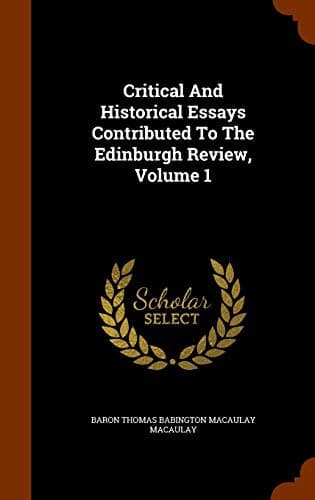
Critical and Historical Essays — Volume 1Macaulay, Thomas Babington Macaulay, Baron
History
Critical and Historical Essays — Volume 1
Macaulay, Thomas Babington Macaulay, Baron
English literature -- History and criticism; Great Britain -- History
But the great security, the security without which every other would
have been insufficient, was the power of the sword. This both parties
thoroughly understood. The Parliament insisted on having the command
of the militia and the direction of the Irish war. “By God, not for an
hour!” exclaimed the King. “Keep the militia,” said the Queen, after
the defeat of the royal party. “Keep the militia; that will bring back
everything.” That, by the old constitution, no military authority was
lodged in the Parliament, Mr. Hallam has clearly shown. That it is a
species of authority which ought, not to be permanently lodged in
large and divided assemblies, must, we think in fairness be conceded.
Opposition, publicity, long discussion, frequent compromise; these
are the characteristics of the proceedings of such assemblies. Unity,
secrecy, decision, are the qualities which military arrangements
require. There were, therefore, serious objections to the proposition
of the Houses on this subject. But, on the other hand, to trust such
a King, at such a crisis, with the very weapon which, in hands less
dangerous, had destroyed so many free constitutions, would have been the
extreme of rashness. The jealousy with which the oligarchy of Venice and
the States of Holland regarded their generals and armies induced them
perpetually to interfere in matters of which they were incompetent to
judge. This policy secured them against military usurpation, but placed
them, under great disadvantages in war. The uncontrolled power which
the King of France exercised over his troops enabled him to conquer
his enemies, but enabled him also to oppress his people. Was there any
intermediate course? None, we confess altogether free from objection.
But on the whole, we conceive that the best measure would have been that
which the Parliament over and over proposed, namely, that for a limited
time the power of the sword should be left to the two Houses, and that
it should revert to the Crown when the constitution should be firmly
established, and when the new securities of freedom should be so far
strengthened by prescription that it would be difficult to employ even a
standing army for the purpose of subverting them.
Public-domain text, read in full here on John Shaqi.
Reviews
Reviews
No reviews yet
Be the first to share your thoughts on this work.
Join the Discussion
Join the discussion
Sign in to leave a comment or review.
Sign InorCreate an account