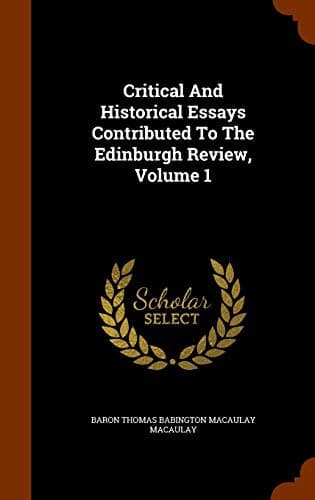
Critical and Historical Essays — Volume 1Macaulay, Thomas Babington Macaulay, Baron
History
Critical and Historical Essays — Volume 1
Macaulay, Thomas Babington Macaulay, Baron
English literature -- History and criticism; Great Britain -- History
nature of man it must be so. The faculty by which we inseparably
associate ideas which have often been presented to us in conjunction
is not under the absolute control of the will. It may be quickened into
morbid activity. It may be reasoned into sluggishness. But in a certain
degree it will always exist. The almost absolute mastery which Mr.
Hallam has obtained over feelings of this class is perfectly astonishing
to us, and will, we believe, be not only astonishing but offensive to
many of his readers. It must particularly disgust those people who, in
their speculations on politics, are not reasoners but fanciers; whose
opinions, even when sincere, are not produced, according to the
ordinary law of intellectual births, by induction or inference, but
are equivocally generated by the heat of fervid tempers out of the
overflowing of tumid imaginations. A man of this class is always
in extremes. He cannot be a friend to liberty without calling for
a community of goods, or a friend to order without taking under his
protection the foulest excesses of tyranny. His admiration oscillates
between the most worthless of rebels and the most worthless of
oppressors, between Marten, the disgrace of the High Court of justice,
and Laud, the disgrace of the Star-Chamber. He can forgive anything but
temperance and impartiality. He has a certain sympathy with the violence
of his opponents, as well as with that of his associates. In every
furious partisan he sees either his present self or his former self,
the pensioner that is, or the Jacobin that has been. But he is unable to
comprehend a writer who, steadily attached to principles, is indifferent
about names and badges, and who judges of characters with equable
severity, not altogether untinctured with cynicism, but free from the
slightest touch of passion, party spirit, or caprice.
We should probably like Mr. Hallam’s book more if, instead of pointing
out with strict fidelity the bright points and the dark spots of both
parties, he had exerted himself to whitewash the one and to blacken the
other. But we should certainly prize it far less. Eulogy and invective
may be had for the asking. But for cold rigid justice, the one weight
and the one measure, we know not where else we can look.
No portion of our annals has been more perplexed and misrepresented by
writers of different parties than the history of the Reformation. In
this labyrinth of falsehood and sophistry, the guidance of Mr. Hallam
is peculiarly valuable. It is impossible not to admire the even-handed
justice with which he deals out castigation to right and left on the
rival persecutors.
Public-domain text, read in full here on John Shaqi.
Reviews
Reviews
No reviews yet
Be the first to share your thoughts on this work.
Join the Discussion
Join the discussion
Sign in to leave a comment or review.
Sign InorCreate an account