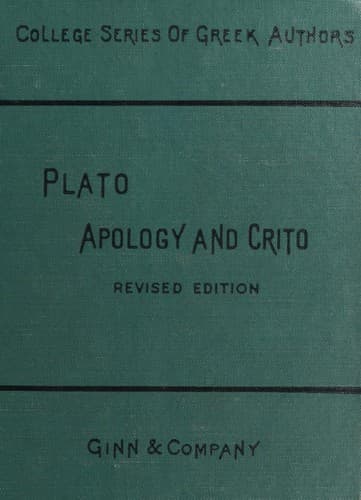
Classical literature; Dialogues, Greek -- Translations into English; Justice -- Early works to 1800; Philosophy, Ancient
SOCRATES: Why, Crito, when a man has reached my age he ought not to be
repining at the approach of death.
CRITO: And yet other old men find themselves in similar misfortunes, and
age does not prevent them from repining.
SOCRATES: That is true. But you have not told me why you come at this
early hour.
CRITO: I come to bring you a message which is sad and painful; not, as I
believe, to yourself, but to all of us who are your friends, and saddest of
all to me.
SOCRATES: What? Has the ship come from Delos, on the arrival of which I
am to die?
CRITO: No, the ship has not actually arrived, but she will probably be
here to-day, as persons who have come from Sunium tell me that they have
left her there; and therefore to-morrow, Socrates, will be the last day of
your life.
SOCRATES: Very well, Crito; if such is the will of God, I am willing; but
my belief is that there will be a delay of a day.
CRITO: Why do you think so?
SOCRATES: I will tell you. I am to die on the day after the arrival of
the ship?
CRITO: Yes; that is what the authorities say.
SOCRATES: But I do not think that the ship will be here until to-morrow;
this I infer from a vision which I had last night, or rather only just now,
when you fortunately allowed me to sleep.
CRITO: And what was the nature of the vision?
SOCRATES: There appeared to me the likeness of a woman, fair and comely,
clothed in bright raiment, who called to me and said: O Socrates,
'The third day hence to fertile Phthia shalt thou go.' (Homer, Il.)
CRITO: What a singular dream, Socrates!
SOCRATES: There can be no doubt about the meaning, Crito, I think.
CRITO: Yes; the meaning is only too clear. But, oh! my beloved Socrates,
let me entreat you once more to take my advice and escape. For if you die
I shall not only lose a friend who can never be replaced, but there is
another evil: people who do not know you and me will believe that I might
have saved you if I had been willing to give money, but that I did not
care. Now, can there be a worse disgrace than this--that I should be
thought to value money more than the life of a friend? For the many will
not be persuaded that I wanted you to escape, and that you refused.
SOCRATES: But why, my dear Crito, should we care about the opinion of the
many? Good men, and they are the only persons who are worth considering,
will think of these things truly as they occurred.
CRITO: But you see, Socrates, that the opinion of the many must be
regarded, for what is now happening shows that they can do the greatest
evil to any one who has lost their good opinion.
SOCRATES: I only wish it were so, Crito; and that the many could do the
greatest evil; for then they would also be able to do the greatest good--
and what a fine thing this would be! But in reality they can do neither;
for they cannot make a man either wise or foolish; and whatever they do is
the result of chance.
Public-domain text, read in full here on John Shaqi.
Reviews
Reviews
No reviews yet
Be the first to share your thoughts on this work.
Join the Discussion
Join the discussion
Sign in to leave a comment or review.
Sign InorCreate an account