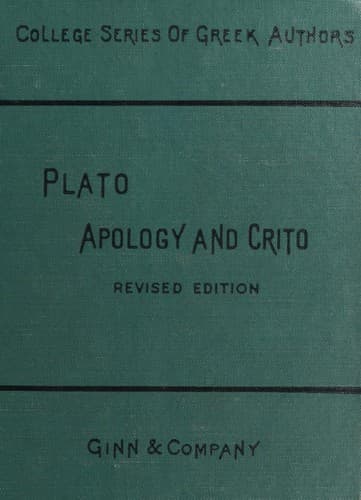
Classical literature; Dialogues, Greek -- Translations into English; Justice -- Early works to 1800; Philosophy, Ancient
mind then, or rather have your mind already made up, for the time of
deliberation is over, and there is only one thing to be done, which must be
done this very night, and if we delay at all will be no longer practicable
or possible; I beseech you therefore, Socrates, be persuaded by me, and do
as I say.
SOCRATES: Dear Crito, your zeal is invaluable, if a right one; but if
wrong, the greater the zeal the greater the danger; and therefore we ought
to consider whether I shall or shall not do as you say. For I am and
always have been one of those natures who must be guided by reason,
whatever the reason may be which upon reflection appears to me to be the
best; and now that this chance has befallen me, I cannot repudiate my own
words: the principles which I have hitherto honoured and revered I still
honour, and unless we can at once find other and better principles, I am
certain not to agree with you; no, not even if the power of the multitude
could inflict many more imprisonments, confiscations, deaths, frightening
us like children with hobgoblin terrors (compare Apol.). What will be the
fairest way of considering the question? Shall I return to your old
argument about the opinions of men?--we were saying that some of them are
to be regarded, and others not. Now were we right in maintaining this
before I was condemned? And has the argument which was once good now
proved to be talk for the sake of talking--mere childish nonsense? That is
what I want to consider with your help, Crito:--whether, under my present
circumstances, the argument appears to be in any way different or not; and
is to be allowed by me or disallowed. That argument, which, as I believe,
is maintained by many persons of authority, was to the effect, as I was
saying, that the opinions of some men are to be regarded, and of other men
not to be regarded. Now you, Crito, are not going to die to-morrow--at
least, there is no human probability of this, and therefore you are
disinterested and not liable to be deceived by the circumstances in which
you are placed. Tell me then, whether I am right in saying that some
opinions, and the opinions of some men only, are to be valued, and that
other opinions, and the opinions of other men, are not to be valued. I ask
you whether I was right in maintaining this?
CRITO: Certainly.
SOCRATES: The good are to be regarded, and not the bad?
CRITO: Yes.
SOCRATES: And the opinions of the wise are good, and the opinions of the
unwise are evil?
CRITO: Certainly.
SOCRATES: And what was said about another matter? Is the pupil who
devotes himself to the practice of gymnastics supposed to attend to the
praise and blame and opinion of every man, or of one man only--his
physician or trainer, whoever he may be?
CRITO: Of one man only.
SOCRATES: And he ought to fear the censure and welcome the praise of that
one only, and not of the many?
CRITO: Clearly so.
Public-domain text, read in full here on John Shaqi.
Reviews
Reviews
No reviews yet
Be the first to share your thoughts on this work.
Join the Discussion
Join the discussion
Sign in to leave a comment or review.
Sign InorCreate an account