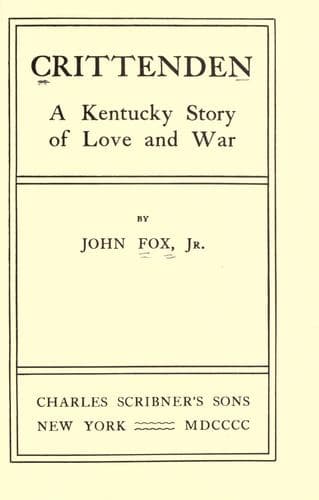
Crittenden: A Kentucky Story of Love and WarFox, John, Jr.
General
Crittenden: A Kentucky Story of Love and War
Fox, John, Jr.
Kentucky -- Fiction; Spanish-American War, 1898 -- Fiction
He knew that national interest would centre in this regiment of Rough
Riders; for every State in the Union had a son in its ranks, and the
sons represented every social element in the national life. Never was
there a more representative body of men, nor a body of more varied
elements standing all on one and the same basis of American manhood. He
recalled how, at Tampa, he had stood with the Colonel while the regiment
filed past, the Colonel, meanwhile, telling him about the men--the
strong men, who made strong stories for Wister and strong pictures for
Remington. And the Colonel had pointed with especial pride and affection
to two boy troopers, who marched at the head of his column--a Puritan
from Massachusetts and a Cavalier through Virginia blood from Kentucky;
one the son of a Confederate General, the other the son of a Union
General--both beardless "bunkies," brothers in arms, and fast becoming
brothers at heart--Robert Sumner and Basil Crittenden. The Colonel waved
his hand toward the wild Westerners who followed them.
"It's odd to think it--but those two boys are the fathers of the
regiment."
And now that Grafton looked around and thought of it again--they were.
The fathers of the regiment had planted Plymouth and Jamestown; had
wrenched life and liberty and civilization from the granite of New
England, the fastnesses of the Cumberland, and the wildernesses of the
rich valleys beyond; while the sires of these very Westerners had gone
on with the same trinity through the barren wastes of plains. And, now,
having conquered the New World, Puritan and Cavalier, and the children
of both were come together again on the same old mission of freedom, but
this time the freedom of others; carrying the fruits of their own
struggle back to the old land from which they came, with the sword in
one hand, if there was need, but with the torch of liberty in the
other--held high, and, as God's finger pointed, lighting the way.
To think what he had missed!
As Grafton walked slowly back, an officer was calling the roll of his
company under the quiet, sunny hill, and he stopped to listen. Now and
then there was no answer, and he went on--thrilled and saddened. The
play was ended--this was war.
Outside the camp the road was full of half-angry, bitterly disappointed
infantry--Chaffee's men. When he reached the camp of the cavalry at the
foot of the hill again, a soldier called his name as he passed--a grimy
soldier--and Grafton stopped in his tracks.
"Well, by God!"
It was Crittenden, who smiled when he saw Grafton's bewildered face.
Then the Kentuckian, too, stared in utter amazement at a black face
grinning over Grafton's shoulder.
"Bob!" he said, sharply.
"Yessuh," said Bob humbly.
"Whar are you doing here?"
"Nothin', Ole Cap'n--jes doin' nothin'," said Bob, with the _naïveté_ of
a child. "Jes lookin' for you."
"Is that your negro?" A sarcastic Lieutenant was asking the question.
"He's my servant, sir."
Public-domain text, read in full here on John Shaqi.
Reviews
Reviews
No reviews yet
Be the first to share your thoughts on this work.
Elsewhere in the archive
Join the Discussion
Join the discussion
Sign in to leave a comment or review.
Sign InorCreate an account