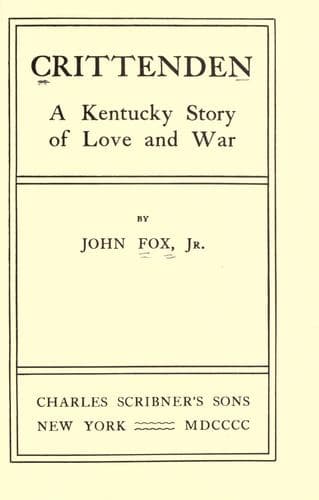
Crittenden: A Kentucky Story of Love and WarFox, John, Jr.
General
Crittenden: A Kentucky Story of Love and War
Fox, John, Jr.
Kentucky -- Fiction; Spanish-American War, 1898 -- Fiction
"Well, we don't allow soldiers to take their valets to the field."
"My servant at home, sir, I meant. He came of his own accord."
[Illustration: "Nothin', Ole Cap'n--jes doin' nothin'--jes lookin' for
you."]
"Go find Basil," Crittenden said to Bob, "and if you can't find him," he
added in a lower tone, "and want anything, come back here to me."
"Yessuh," said Bob, loath to go, but, seeing the Lieutenant scowling, he
moved on down the road.
"I thought you were a Captain," said Grafton. Crittenden laughed.
"Not exactly."
"Forward," shouted the Lieutenant, "march!"
Grafton looked Crittenden over.
"Well, I swear," he said heartily, and, as Crittenden moved forward,
Grafton stood looking after him. "A regular--I do be damned!"
That night Basil wrote home. He had not fired his musket a single time.
He saw nothing to shoot at, and he saw no use shooting until he did have
something to shoot at. It was terrible to see men dead and wounded, but
the fight itself was stupid--blundering through a jungle, bullets
zipping about, and the Spaniards too far away and invisible. He wanted
to be closer.
"General Carter has sent for me to take my place on his staff. I don't
want to go, but the Colonel says I ought. I don't believe I would, if
the General hadn't been father's friend and if my 'bunkie' weren't
wounded. He's all right, but he'll have to go back. I'd like to have
his wound, but I'd hate to have to go back. The Colonel says he's sorry
to lose me. He meant to make me a corporal, he says. I don't know what
for--but Hooray!
"Brother was not in the fight, I suppose. Don't worry about me--please
don't worry.
"P. S.--I have often wondered what it would be like to be on the eve of
a battle. It's no different from anything else."
Abe Long and Crittenden were bunkies now. Abe's comrade, the boy
Sanders, had been wounded and sent to the rear. Reynolds, too, was shot
through the shoulder, and, despite his protests, was ordered back to the
coast.
"Oh, I'll be on hand for the next scrap," he said.
Abe and Crittenden had been side by side in the fight. It was no
surprise to Crittenden that any man was brave. By his code, a man would
be better dead than alive a coward. He believed cowardice exceptional
and the brave man the rule, but he was not prepared for Abe's coolness
and his humour. Never did the Westerner's voice change, and never did
the grim half-smile leave his eyes or his mouth. Once during the fight
he took off his hat.
"How's my hair parted?" he asked, quietly.
A Mauser bullet had mowed a path through Abe's thick, upright hair,
scraping the skin for three inches, and leaving a trail of tiny, red
drops. Crittenden turned to look and laugh, and a bullet cut through the
open flap of his shirt, just over his heart. He pointed to it.
"See the good turn you did me."
While the two were cooking supper, the old Sergeant came up.
Public-domain text, read in full here on John Shaqi.
Reviews
Reviews
No reviews yet
Be the first to share your thoughts on this work.
Elsewhere in the archive
Join the Discussion
Join the discussion
Sign in to leave a comment or review.
Sign InorCreate an account