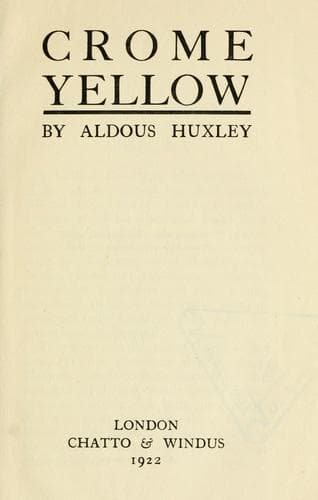
Country homes -- Fiction; England -- Fiction; Humorous stories; Intellectuals -- Fiction; Satire
“Then there are military uniforms,” Mr. Scogan went on. “When scarlet
and pipe-clay were abandoned for khaki, there were some who trembled for
the future of war. But then, finding how elegant the new tunic was, how
closely it clipped the waist, how voluptuously, with the lateral
bustles of the pockets, it exaggerated the hips; when they realized the
brilliant potentialities of breeches and top-boots, they were reassured.
Abolish these military elegances, standardise a uniform of sack-cloth
and mackintosh, you will very soon find that...”
“Is anyone coming to church with me this morning?” asked Henry Wimbush.
No one responded. He baited his bare invitation. “I read the lessons,
you know. And there’s Mr. Bodiham. His sermons are sometimes worth
hearing.”
“Thank you, thank you,” said Mr. Barbecue-Smith. “I for one prefer to
worship in the infinite church of Nature. How does our Shakespeare put
it? ‘Sermons in books, stones in the running brooks.’” He waved his arm
in a fine gesture towards the window, and even as he did so he became
vaguely, but none the less insistently, none the less uncomfortably
aware that something had gone wrong with the quotation. Something--what
could it be? Sermons? Stones? Books?
CHAPTER IX.
Mr. Bodiham was sitting in his study at the Rectory. The
nineteenth-century Gothic windows, narrow and pointed, admitted the
light grudgingly; in spite of the brilliant July weather, the room was
sombre. Brown varnished bookshelves lined the walls, filled with row
upon row of those thick, heavy theological works which the second-hand
booksellers generally sell by weight. The mantelpiece, the over-mantel,
a towering structure of spindly pillars and little shelves, were brown
and varnished. The writing-desk was brown and varnished. So were the
chairs, so was the door. A dark red-brown carpet with patterns covered
the floor. Everything was brown in the room, and there was a curious
brownish smell.
In the midst of this brown gloom Mr. Bodiham sat at his desk. He was the
man in the Iron Mask. A grey metallic face with iron cheek-bones and a
narrow iron brow; iron folds, hard and unchanging, ran perpendicularly
down his cheeks; his nose was the iron beak of some thin, delicate bird
of rapine. He had brown eyes, set in sockets rimmed with iron; round
them the skin was dark, as though it had been charred. Dense wiry hair
covered his skull; it had been black, it was turning grey. His ears
were very small and fine. His jaws, his chin, his upper lip were dark,
iron-dark, where he had shaved. His voice, when he spoke and especially
when he raised it in preaching, was harsh, like the grating of iron
hinges when a seldom-used door is opened.
Public-domain text, read in full here on John Shaqi.
Reviews
Reviews
No reviews yet
Be the first to share your thoughts on this work.
Join the Discussion
Join the discussion
Sign in to leave a comment or review.
Sign InorCreate an account