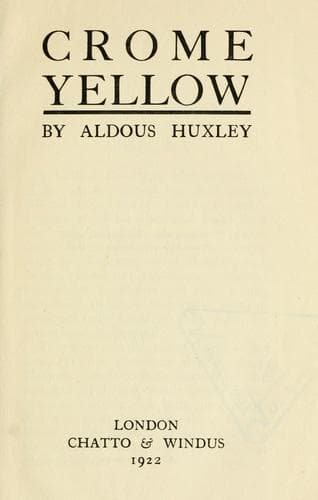
Country homes -- Fiction; England -- Fiction; Humorous stories; Intellectuals -- Fiction; Satire
“Eccentricity...It’s the justification of all aristocracies. It
justifies leisured classes and inherited wealth and privilege and
endowments and all the other injustices of that sort. If you’re to do
anything reasonable in this world, you must have a class of people who
are secure, safe from public opinion, safe from poverty, leisured, not
compelled to waste their time in the imbecile routines that go by the
name of Honest Work. You must have a class of which the members can
think and, within the obvious limits, do what they please. You must have
a class in which people who have eccentricities can indulge them and in
which eccentricity in general will be tolerated and understood. That’s
the important thing about an aristocracy. Not only is it eccentric
itself--often grandiosely so; it also tolerates and even encourages
eccentricity in others. The eccentricities of the artist and the
new-fangled thinker don’t inspire it with that fear, loathing, and
disgust which the burgesses instinctively feel towards them. It is a
sort of Red Indian Reservation planted in the midst of a vast horde of
Poor Whites--colonials at that. Within its boundaries wild men disport
themselves--often, it must be admitted, a little grossly, a little too
flamboyantly; and when kindred spirits are born outside the pale it
offers them some sort of refuge from the hatred which the Poor Whites,
en bons bourgeois, lavish on anything that is wild or out of the
ordinary. After the social revolution there will be no Reservations;
the Redskins will be drowned in the great sea of Poor Whites. What then?
Will they suffer you to go on writing villanelles, my good Denis? Will
you, unhappy Henry, be allowed to live in this house of the splendid
privies, to continue your quiet delving in the mines of futile
knowledge? Will Anne...”
“And you,” said Anne, interrupting him, “will you be allowed to go on
talking?”
“You may rest assured,” Mr. Scogan replied, “that I shall not. I shall
have some Honest Work to do.”
CHAPTER XII.
Blight, Mildew, and Smut...” Mary was puzzled and distressed. Perhaps
her ears had played her false. Perhaps what he had really said was,
“Squire, Binyon, and Shanks,” or “Childe, Blunden, and Earp,” or even
“Abercrombie, Drinkwater, and Rabindranath Tagore.” Perhaps. But then
her ears never did play her false. “Blight, Mildew, and Smut.” The
impression was distinct and ineffaceable. “Blight, Mildew...” she was
forced to the conclusion, reluctantly, that Denis had indeed pronounced
those improbable words. He had deliberately repelled her attempts to
open a serious discussion. That was horrible. A man who would not talk
seriously to a woman just because she was a woman--oh, impossible!
Egeria or nothing. Perhaps Gombauld would be more satisfactory. True,
his meridional heredity was a little disquieting; but at least he was
a serious worker, and it was with his work that she would associate
herself. And Denis? After all, what WAS Denis? A dilettante, an
amateur...
Public-domain text, read in full here on John Shaqi.
Reviews
Reviews
No reviews yet
Be the first to share your thoughts on this work.
Join the Discussion
Join the discussion
Sign in to leave a comment or review.
Sign InorCreate an account