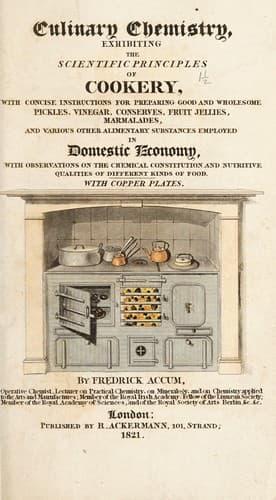
Culinary Chemistry: The Scientific Principles of Cookery, with Concise Instructions for Preparing Good and Wholesome Pickles, Vinegar, Conserves, Fruit Jellies, Marmalades, and Various Other Alimentary Substances Employed in Domestic Economy, with Observations on the Chemical Constitution and Nutritive Qualities of Different Kinds of Food.Accum, Friedrich Christian
Science
Culinary Chemistry: The Scientific Principles of Cookery, with Concise Instructions for Preparing Good and Wholesome Pickles, Vinegar, Conserves, Fruit Jellies, Marmalades, and Various Other Alimentary Substances Employed in Domestic Economy, with Observations on the Chemical Constitution and Nutritive Qualities of Different Kinds of Food.
Accum, Friedrich Christian
Cooking; Food poisoning
“Stewpans and soup-kettles should be examined every time they are used;
these, and their covers, must be kept perfectly clean and well tinned,
not only on the inside, but about a couple of inches on the outside; so
much mischief arises from their getting out of repair; and, if not kept
nicely tinned, all your work will be in vain; the broths and soups will
look green and dirty, and taste bitter and poisonous, and will be
spoiled both for the eye and palate, and your credit will be lost; and,
as the health, and even the life, of the family depends upon this, the
cook may be sure her employer had rather pay the tinman’s bill than the
doctor’s.”
Various kinds of food used in domestic economy are liable to become
impregnated with lead.
The glazing of the common cream-coloured earthen ware, which is composed
of an oxyd of lead, readily yields to the action of vinegar and saline
compounds; and therefore the jars and pots of this kind of stoneware,
should not be used for marmalades and other conserves. Pickles should in
no case be deposited in cream-coloured glazed earthenware pots.
The baking of fruit tarts in cream-coloured earthenware is no less
objectionable All kinds of food which contain free vegetable acids, or
saline preparations, attack utensils covered with a glaze, in the
composition of which lead enters as a component part.
_Wooden Tubs_ lined with lead, should not, as they often are, be used
for salting meat, as the salt brine corrodes the lead, and all compounds
of this metal are dangerous to health.
FINIS.
C. GREEN, 15, LEICESTER STREET, LEICESTER SQUARE.
Transcriber’s Notes
The language from the source document, including inconsistencies and
unusual spellings, has been retained, except as listed below.
Missing accents in French words and phrases have not been added.
Page 140, Before the trumpets calls ...: as printed in the source
document.
Page 304, ... in Adea, in Arabia, ...: possibly an error for ... in
Aden, in Arabia, ....
Changes made
Footnotes have been moved to immediately underneath the text element
to which they belong.
Some minor obvious punctuation and typographical errors have been
corrected silently.
Page xiii: page number 356 changed to 336
Page 7: rabit changed to rabbit
Page 16: Gastronomque changed to Gastronomique
Page 24: The pleasure of the table changed to The pleasures of the
table
Page 138: “ added before _Point des Legumes ..._
Page 140: qui fail le Soldat changed to qui fait le Soldat
Page 158: parsly changed to parsley
Page 161: gelantine changed to gelatine
Page 200-204: several opening and closing quote marks inserted
Page 202: vogages changed to voyages
Page 261: Chery Paste changed to Cherry Paste
Page 262: ORANGE AND LEMOM PASTE changed to ORANGE AND LEMON PASTE
Page 325: covenient changed to convenient
End of the Project Gutenberg EBook of Culinary Chemistry, by Frederick Accum
Public-domain text, read in full here on John Shaqi.
Reviews
Reviews
No reviews yet
Be the first to share your thoughts on this work.
Elsewhere in the archive
Join the Discussion
Join the discussion
Sign in to leave a comment or review.
Sign InorCreate an account