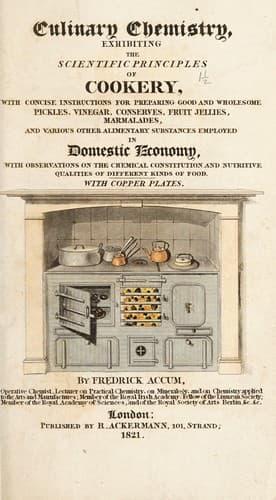
Culinary Chemistry: The Scientific Principles of Cookery, with Concise Instructions for Preparing Good and Wholesome Pickles, Vinegar, Conserves, Fruit Jellies, Marmalades, and Various Other Alimentary Substances Employed in Domestic Economy, with Observations on the Chemical Constitution and Nutritive Qualities of Different Kinds of Food.Accum, Friedrich Christian
Science
Culinary Chemistry: The Scientific Principles of Cookery, with Concise Instructions for Preparing Good and Wholesome Pickles, Vinegar, Conserves, Fruit Jellies, Marmalades, and Various Other Alimentary Substances Employed in Domestic Economy, with Observations on the Chemical Constitution and Nutritive Qualities of Different Kinds of Food.
Accum, Friedrich Christian
Cooking; Food poisoning
Copper cooking utensils are attended with so much danger, that the use
of them ought to be laid entirely aside. They have not only occasioned
many fatal accidents, (which have been made public), but they have
injured the health of great numbers, where the slower, but not less
dangerous effect has not been observed. If not kept very clean and
bright, they become covered with verdigris, for all fat, oily, or
buttery substances corrode copper; and if they are kept clean and
bright, the rubbing or scraping that takes place when making stews, or
cooking dishes that require stirring, and remaining a considerable time
on the fire, always wears off some of the metal which impregnates the
food, and has a deleterious effect.
The inexcusable negligence of persons who make use of copper vessels has
been productive of mortality, so much more terrible, as they have
exerted their action on a great number of persons at once.
Though, after all, a single dose be not mortal, yet a quantity of
poison, however small, when taken at every meal, must produce more fatal
effects than are generally apprehended; and different constitutions are
differently affected by minute quantities of substances that act
powerfully on the system.
Some years ago, the death of several persons was occasioned, at
Salt-hill, by the cook sending a ragout to the table which she had kept
from the preceding day in a copper vessel, badly tinned. Another
instance of death occasioned by the eating of pickles, prepared in
copper vessels, is mentioned by Dr. Percival.[41]
[41] See a Treatise on the Adulteration of Food and Culinary Poisons,
and Methods of Detecting them, p. 249.
Dr. Johnson gives an account of the melancholy catastrophe of three men
being poisoned, after excruciating sufferings, in consequence of eating
food cooked in an unclean copper vessel, on board the Cyclops frigate;
and, besides these, thirty-three men became ill from the same cause.
If, however, copper utensils are to be used, they should be employed
with the precautions as used in France, where the tinning of the vessels
on the inside is done as regularly as the shoeing of horses in a
farm-yard.--If the least occasion is thought to exist, the vessel is
immediately tinned; but to prevent all risk, it is generally done _once
a month_ with stew-pans that are in daily use. Moreover, the victuals
are never stirred with any thing of metal, but with a wooden spoon, or
flat stick made for the purpose.
The following wholesome advice on this subject is given to cooks by Dr.
Kitchiner.
Public-domain text, read in full here on John Shaqi.
Reviews
Reviews
No reviews yet
Be the first to share your thoughts on this work.
Elsewhere in the archive
Join the Discussion
Join the discussion
Sign in to leave a comment or review.
Sign InorCreate an account