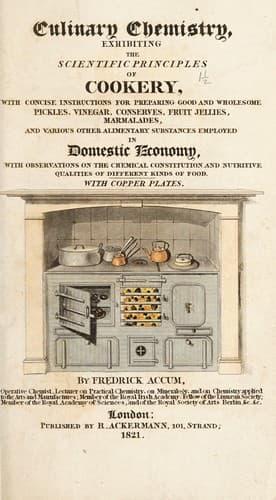
Culinary Chemistry: The Scientific Principles of Cookery, with Concise Instructions for Preparing Good and Wholesome Pickles, Vinegar, Conserves, Fruit Jellies, Marmalades, and Various Other Alimentary Substances Employed in Domestic Economy, with Observations on the Chemical Constitution and Nutritive Qualities of Different Kinds of Food.Accum, Friedrich Christian
Science
Culinary Chemistry: The Scientific Principles of Cookery, with Concise Instructions for Preparing Good and Wholesome Pickles, Vinegar, Conserves, Fruit Jellies, Marmalades, and Various Other Alimentary Substances Employed in Domestic Economy, with Observations on the Chemical Constitution and Nutritive Qualities of Different Kinds of Food.
Accum, Friedrich Christian
Cooking; Food poisoning
In later times, Dr. Johnson is well known to have been exceedingly fond
of good dinners, considering them as the highest enjoyment of human
life. The sentiments of our great moralist are a good answer to those
who think the pleasures of the table incompatible with intellectual
pursuits or mental superiority. “Some people,” says the Doctor, “have a
foolish way of not minding, or pretending not to mind, what they eat;
for my part, I mind my belly very studiously, and very carefully, and I
look upon it that he who does not mind his belly will hardly mind any
thing else.” Boswell, his biographer, says of him, “I never knew a man
who relished good eating more than he did: and when at table, he was
wholly absorbed in the business of the moment.” It was one of the
objects which displeased him so much in his Northern tour, that the
Scots were rather ignorant of the more refined arts of cookery. A lady
in the Isle of Mull, anxious to gratify him for once in a dinner, had an
excellent plum-pudding prepared, at some expense, and with the utmost
care; but, to her great mortification, the doctor would not taste it,
because, he said, “it is totally impossible to make a plum-pudding at
all fit to eat in the Isle of Mull.”
Another instance of this philosopher’s illiberal prejudice against
Scotch cookery, may also be mentioned. A lady, at whose table the Doctor
was dining, enquired how he liked their national dish, the _hotch
potch_, of which he was then partaking. “_Good enough for hogs_,” said
the surly philosopher. “Shall I help _you_ to a little more of it?”
retorted the lady. To Dr. Johnson we can add the names of two
distinguished physicians, Darwin, and Beddoes, both of whom were most
outrageous in their published works against the pleasures of good
living; they followed however a very different practice, from what they
prescribed to others, as none were more fond of good dinners than these
guardians of health.
Cardinal Wolsey, we should have thought, would have had something else
to mind than cooking and good eating. But no person was more anxious
than he, even in the whirl of the immense public business which he had
to transact, to have the most skilful cooks; for all Europe was
ransacked, and no expense spared, to procure culinary operators,
thoroughly acquainted with the multifarious operations of the spit, the
stew-pan, and the rolling-pin.
Sir Walter Scott, has been most happy in the illustration of our ancient
manners with respect to good eating, in the character of Athelstan, in
the Romance of Ivanhoe.
Reviews
Reviews
No reviews yet
Be the first to share your thoughts on this work.
Join the Discussion
Join the discussion
Sign in to leave a comment or review.
Sign InorCreate an account