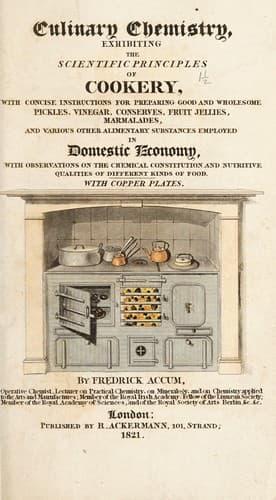
Culinary Chemistry: The Scientific Principles of Cookery, with Concise Instructions for Preparing Good and Wholesome Pickles, Vinegar, Conserves, Fruit Jellies, Marmalades, and Various Other Alimentary Substances Employed in Domestic Economy, with Observations on the Chemical Constitution and Nutritive Qualities of Different Kinds of Food.Accum, Friedrich Christian
Science
Culinary Chemistry: The Scientific Principles of Cookery, with Concise Instructions for Preparing Good and Wholesome Pickles, Vinegar, Conserves, Fruit Jellies, Marmalades, and Various Other Alimentary Substances Employed in Domestic Economy, with Observations on the Chemical Constitution and Nutritive Qualities of Different Kinds of Food.
Accum, Friedrich Christian
Cooking; Food poisoning
The following pages are intended to exhibit a popular view of the
philosophy of cookery, to enable the reader to understand the chemical
principles, by means of which alimentary substances are rendered
palatable and nutritious. The subject may appear frivolous; but let it
be remembered that it is by the application of the principles of
philosophy to the ordinary affairs of life, that science diffuses her
benefits, and perfects her claim to the gratitude of mankind.
The art of preparing good and wholesome food is, undoubtedly, a branch
of chemistry; the kitchen is a chemical laboratory; all the processes
employed for rendering alimentary substances fit for human sustenance,
are chemical processes; and much waste of the materials, as well as
labour to the parties, might often be spared, were those who practise
this art, made acquainted with some simple chemical truths which
invariably would lead to certain results.
I have, in the first place, premised, as introductory to what follows,
some general observations on the various kinds of alimentary substances
commonly used for food; in which I have noticed their chemical
constitution, and comparative nutritive qualities.
After these preliminary statements, I have proceeded to explain the
summary processes of the culinary art, as practised in the English
kitchen, to render obvious the chemical effects produced by the
operations of roasting, boiling, stewing, broiling, frying, and other
means employed for dressing food.
I have given concise, but accurate directions for preparing good and
wholesome pickles, and other condiments employed in domestic economy.
I have pointed out the rules to be attended to in the art of conserving
recent fruits, and other vegetable substances, in the state of what are
called preserves, marmalades, fruit jams, and jellies, to enable the
reader to prepare those kinds of comfitures with economy and success.
I have given concise directions for preserving butcher’s meat, fish, and
fowl, after being cooked, to render them fit for sea store, or domestic
use, at a future time.
I have stated the most approved processes for curing bacon, hams, smoked
beef, and salted fish; to which I have added instructions for the choice
of butcher’s meat, and the best methods of constructing pantries,
larders, and meat safes.
I have pointed out the loss of weight which different kinds of meat
suffers in the usual operations of cooking.
I have described the most approved methods for preserving recently
gathered fruits in their natural state, as nearly as possible, with
directions for constructing fruit rooms, and the circumstances to be
attended to in storing esculent roots and other vegetables.
Reviews
Reviews
No reviews yet
Be the first to share your thoughts on this work.
Join the Discussion
Join the discussion
Sign in to leave a comment or review.
Sign InorCreate an account