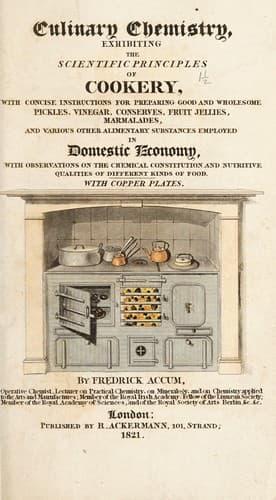
Culinary Chemistry: The Scientific Principles of Cookery, with Concise Instructions for Preparing Good and Wholesome Pickles, Vinegar, Conserves, Fruit Jellies, Marmalades, and Various Other Alimentary Substances Employed in Domestic Economy, with Observations on the Chemical Constitution and Nutritive Qualities of Different Kinds of Food.Accum, Friedrich Christian
Science
Culinary Chemistry: The Scientific Principles of Cookery, with Concise Instructions for Preparing Good and Wholesome Pickles, Vinegar, Conserves, Fruit Jellies, Marmalades, and Various Other Alimentary Substances Employed in Domestic Economy, with Observations on the Chemical Constitution and Nutritive Qualities of Different Kinds of Food.
Accum, Friedrich Christian
Cooking; Food poisoning
The effects of the processes of cookery on vegetable substances, though
usually very slight and simple, are in some instances both striking and
unexpected. For example, some sorts of vegetables are extremely acrid
and even poisonous in their crude state, and altogether unfit for human
food; yet, by simply boiling them in water, they become bland, sweet,
and wholesome. Several species of _arum_ (cuckoo-pint), which are very
acrid, and would be dangerous to use raw, become quite palatable
pot-herbs when boiled. Their acrimony must reside in a very volatile
principle, which, during the boiling, makes its escape, or is chemically
altered; but the nature of this principle has not yet been accurately
investigated by chemists. A more familiar example than this is found in
onions, leeks, and garlick, whose acrimony and strong odour can be
almost destroyed, or rather driven off by a sufficiently long
application of heat, either directly, or through the medium of water.
Many other instances could be given, but we shall content ourselves with
one more.
Every body knows that potatoes, in a raw state, are nauseous and
unpalatable. It is not, perhaps, so generally known that the potatoe,
(_solanum tuberosum_,) belongs to the night-shade genus of plants, which
are all more or less poisonous. If potatoes were used raw, in any
quantity, they would be deleterious to man; nor does it disprove this
that cattle eat them with impunity, as sheep and goats eat plants much
more strongly poisonous to man, such as hemlockdropwort, [_oenanthe
crocata_;] and waterhemlock, [_phelandrium aquaticum_].
By boiling or roasting, however, all the unpalatable and all the
unwholesome qualities of the potatoe are changed, and it becomes
farinaceous, wholesome, digestible, and highly nutritious. Yet, although
this change is remarkable, and could scarcely have been anticipated,
very little is lost and nothing is added to the potatoe by either
roasting or boiling, yet its immediate constituent parts have evidently
suffered a very great chemical alteration, chiefly, in consequence it
should seem, from the farinaceous substance being acted on by water.
Vegetables, when used as food, are most commonly boiled, and seldom
baked or roasted. Salads, indeed, are eaten raw, without any application
of heat. The chemical action of heat on pot-herbs, on esculent roots,
and leguminous seeds, does not appear to be confined to the mere
softening of their fibres, or to the solution or coagulation of some of
their juices and component parts; for we have just now seen that their
flavour, and other sensible qualities, as well as their texture, suffer
a remarkable chemical change, which greatly improves their alimentary
properties.
Public-domain text, read in full here on John Shaqi.
Reviews
Reviews
No reviews yet
Be the first to share your thoughts on this work.
Join the Discussion
Join the discussion
Sign in to leave a comment or review.
Sign InorCreate an account