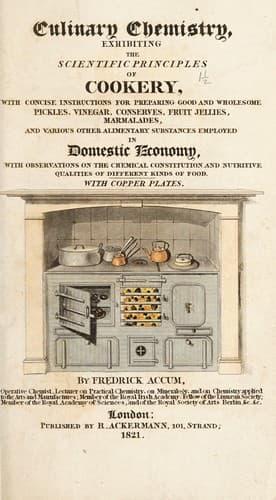
Culinary Chemistry: The Scientific Principles of Cookery, with Concise Instructions for Preparing Good and Wholesome Pickles, Vinegar, Conserves, Fruit Jellies, Marmalades, and Various Other Alimentary Substances Employed in Domestic Economy, with Observations on the Chemical Constitution and Nutritive Qualities of Different Kinds of Food.Accum, Friedrich Christian
Science
Culinary Chemistry: The Scientific Principles of Cookery, with Concise Instructions for Preparing Good and Wholesome Pickles, Vinegar, Conserves, Fruit Jellies, Marmalades, and Various Other Alimentary Substances Employed in Domestic Economy, with Observations on the Chemical Constitution and Nutritive Qualities of Different Kinds of Food.
Accum, Friedrich Christian
Cooking; Food poisoning
In the cooking of vegetables, saccharine matter is often formed, or
mucilage and jelly extracted; and the whole substance is on that account
rendered more palatable, wholesome, and nourishing. These effects are
very well exemplified in the changes which take place in flour when
converted into bread;[24] which differs materially from flour paste,
insomuch that the constituent parts of the unbaked dough can no longer
be separated by the processes employed in chemical analysis.
[24] A treatise on the _art_ of making good and _wholesome_ bread of
wheat, oats, rye, barley, and other farinaceous grain, exhibiting the
alimentary properties and chemical constitution of different kinds of
bread corn, and of the various substitutes used for bread, in
different parts of the world, p. 58, 1821.
Vegetable substances are most commonly boiled or baked; or, if
occasionly fried or roasted, there is always much water present, which
prevents the greater action of the fire from penetrating below the
surface. The universal effect of cookery by boiling upon vegetable
substances, is to dissolve in the water some of their constituents, such
as the mucilage and starch, and to render those that are not properly
soluble, as the gluten and fibre, softer and more pulpy.
COMPARATIVE DIMINUTION OF THE WEIGHT OF MEAT IN COOKING.
It is evident, that whether the heat be applied directly or indirectly
for cooking animal food, there must be a considerable diminution of
weight. In the cooking of animal substances in public institutions,
where the allowance of meat is generally weighed out in its raw state,
and includes bones, and is served out cooked, and sometimes without
bone, it is a matter of importance to ascertain nearly their relative
proportions. Much, no doubt, depends upon the piece of the meat cooked,
and the degree of cookery, and the attention bestowed on it. Persons who
salt rounds of beef to sell by retail, after it is boiled, get 19 lbs.
of cold boiled beef from 25 lbs. raw; but the meat is always rather
underdone.
Messrs. Donkin and Gamble boiled in steam 56 lbs. of captain’s salt
beef; the meat, when cold, without the bones, which amounted to 5 lbs. 6
oz. weighed only 35 lbs.
In another experiment, 113 lbs. of prime mess beef, gave 9 lbs. 10 oz.
of bones, and 47 lbs. 8 oz. meat; and in a third, 213 lbs. mess beef
gave 13 lbs. 8 oz. bones, and 103 lbs. 10 oz. meat; or, taken in the
aggregate, 372 lbs. of salt beef, including bones, furnish, when boiled,
186 lbs. 2 oz., without bone, being about 50 _per cent._; or,
disregarding the bone altogether, salt meat loses, by boiling, about
44.2 per cwt. or nearly half.
Public-domain text, read in full here on John Shaqi.
Reviews
Reviews
No reviews yet
Be the first to share your thoughts on this work.
Join the Discussion
Join the discussion
Sign in to leave a comment or review.
Sign InorCreate an account