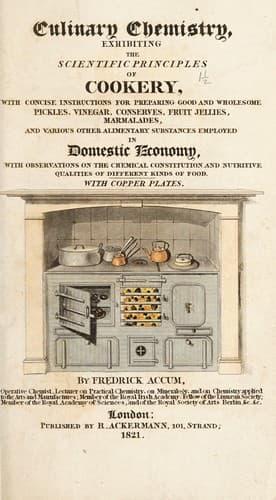
Culinary Chemistry: The Scientific Principles of Cookery, with Concise Instructions for Preparing Good and Wholesome Pickles, Vinegar, Conserves, Fruit Jellies, Marmalades, and Various Other Alimentary Substances Employed in Domestic Economy, with Observations on the Chemical Constitution and Nutritive Qualities of Different Kinds of Food.Accum, Friedrich Christian
Science
Culinary Chemistry: The Scientific Principles of Cookery, with Concise Instructions for Preparing Good and Wholesome Pickles, Vinegar, Conserves, Fruit Jellies, Marmalades, and Various Other Alimentary Substances Employed in Domestic Economy, with Observations on the Chemical Constitution and Nutritive Qualities of Different Kinds of Food.
Accum, Friedrich Christian
Cooking; Food poisoning
We are indebted to Professor Wallace (of Edinburgh) for the detail of a
very accurate and extensive experiment in a public establishment, of
which the results were, that, in pieces of 10 lbs. weight, each 100 lbs.
of BEEF lost, on an average, by _boiling_, 26.4; _baking_, 30.2; and
_roasting_, 32.2: MUTTON, the leg, by _boiling_, 21.4; by _roasting_ the
shoulder, 31.1; the neck, 32.4; the loin, 35.9. Hence, generally
speaking, _mutton_ loses, by boiling, about one-fifth of its original
weight, and _beef_ about one-fourth; again, _mutton_ and _beef_ lose, by
_roasting_, about one-third of their original weight.
The loss arises, in roasting, from the melting out of the fat and the
evaporation of the watery part of the juices, but the nutritious matters
remain condensed in the solid meat when cooked; but in boiling, the
loss arises partly from fat melted out, but chiefly from gelatine and
osmazome becoming dissolved in the water in which the meat is boiled;
there is, therefore, a real loss of nutritive matter in boiling, unless
the broth be used, when this mode of cooking becomes the most
economical.
PRIMARY OR CHIEF DISHES OF THE ENGLISH TABLE.
The principal or chief dishes that are prepared for the English table,
what the scientific cooks for the marshals and generals of France would
term _dishes of the first order_, are few in number. _Flesh_, _fowl_ and
_fish_, roasted, boiled or fried, accompanied by some simple and easy
made puddings and pies, are the primary dishes of an English table.
Soups and broths are less generally made use of; and the flesh, fowl and
fish, served up in made dishes, are, like the lord mayor in his state
coach, generally less noticed than the attendants.
BROTH
May be defined a weak decoction of meat, slightly seasoned with the
addition of aromatic herbs, roots or spices, in which the flavour of the
meat greatly predominates.
To produce a high flavoured broth, it is essential that the boiling of
the meat be moderate, and continued for some time; the simmering should
be done in a vessel nearly closed. Cooks consider it essential that the
broth be clear; the scum, or albumen of the meat, which becomes
coagulated and rises to the surface during the boiling, must therefore
be removed from time to time.
The meat employed for broth (and also for soup and gravy), should be
fresh, for if in the slightest degree tainted or musty, it infallibly
communicates a very disagreeable taste to the broth; besides, fresh meat
gives a more savoury broth than meat that has been kept for two or three
days. It is also advisable to score the meat and to cut it into slices,
or to bruise it with a mallet or cleaver.
Public-domain text, read in full here on John Shaqi.
Reviews
Reviews
No reviews yet
Be the first to share your thoughts on this work.
Join the Discussion
Join the discussion
Sign in to leave a comment or review.
Sign InorCreate an account