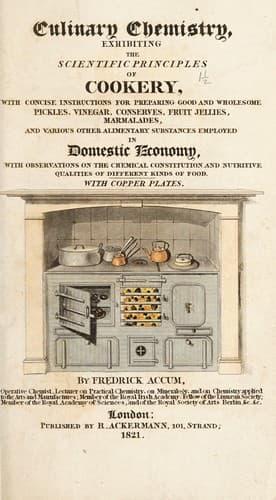
Culinary Chemistry: The Scientific Principles of Cookery, with Concise Instructions for Preparing Good and Wholesome Pickles, Vinegar, Conserves, Fruit Jellies, Marmalades, and Various Other Alimentary Substances Employed in Domestic Economy, with Observations on the Chemical Constitution and Nutritive Qualities of Different Kinds of Food.Accum, Friedrich Christian
Science
Culinary Chemistry: The Scientific Principles of Cookery, with Concise Instructions for Preparing Good and Wholesome Pickles, Vinegar, Conserves, Fruit Jellies, Marmalades, and Various Other Alimentary Substances Employed in Domestic Economy, with Observations on the Chemical Constitution and Nutritive Qualities of Different Kinds of Food.
Accum, Friedrich Christian
Cooking; Food poisoning
Two pounds of muscular beef scored and cut into slices, affords a
stronger and far more savoury broth, than 3 lbs. of the same beef when
boiled in one piece. Cooks usually allow for good broth, one pound of
muscular meat, to two quarts of water, and they suffer the fluid to
simmer till reduced, by evaporation, to one pint, or one pint and a
half. A second decoction may be made by again covering the meat with a
less quantity of water, and suffering it to boil, taking care to supply
the water from time to time as it becomes evaporated.
This reminds us of Rabelais, the humorous vicar of Meudon, who
distinguishes, in his jocose way, two sorts of broths. (_Bouillon de
Prime_,) prime-broth; and broth good for hounds; (_Bouillon de
levriers_,) the meaning of which stands as follows.[25] The first
designates that premature delibation of broth which the young monks in
the convent used to steal, when they could, from the kitchen, in their
way to the choir at the hour of “_Prime_,” a service which was performed
at about seven or eight in the morning, when the porridge-pot, with all
its ingredients, had been boiling for the space of one or two hours,
and when the broth, full of eyes swimming gently on the golden surface,
had already obtained an interesting appearance and taste. On the
contrary, greyhound’s broth, (_Bouillon de levriers_,) means that
portion of the porridge which was served to the novices after an ample
_presumption_ in favour of the _Magnates_ of the monastery. This was
good for nothing, and monks of inferior ranks were ready to throw it to
the dogs.
[25] Tabella Cibaria, p. 23.
The flavouring ingredients, which are usually the domestic pot-herbs and
indigenous roots, such as cellery, carrots, &c. should be added at the
end of the process, to prevent their aromatic substances becoming
dissipated by long simmering.
Dr. Kitchener[26] says, “meat from which broth has been made, is
excellently well prepared for _potting_, and is quite as good, or
better than that which has been boiled, till it is dry.”
[26] The Cook’s Oracle, p. 103.
SOUP.
Soups are decoctions of meat which differ from broth, in being more
concentrated, and usually also more complex in their composition. They
are in fact strong broths, containing either farinaceous roots and
seeds, or other parts of vegetable substances.
Public-domain text, read in full here on John Shaqi.
Reviews
Reviews
No reviews yet
Be the first to share your thoughts on this work.
Join the Discussion
Join the discussion
Sign in to leave a comment or review.
Sign InorCreate an account