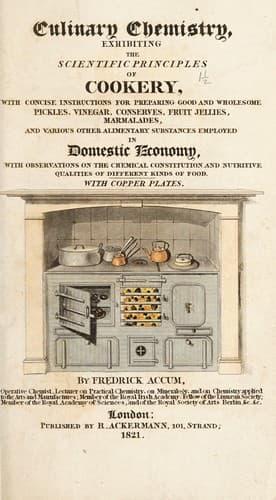
Culinary Chemistry: The Scientific Principles of Cookery, with Concise Instructions for Preparing Good and Wholesome Pickles, Vinegar, Conserves, Fruit Jellies, Marmalades, and Various Other Alimentary Substances Employed in Domestic Economy, with Observations on the Chemical Constitution and Nutritive Qualities of Different Kinds of Food.Accum, Friedrich Christian
Science
Culinary Chemistry: The Scientific Principles of Cookery, with Concise Instructions for Preparing Good and Wholesome Pickles, Vinegar, Conserves, Fruit Jellies, Marmalades, and Various Other Alimentary Substances Employed in Domestic Economy, with Observations on the Chemical Constitution and Nutritive Qualities of Different Kinds of Food.
Accum, Friedrich Christian
Cooking; Food poisoning
The erudite editor of the “_Almanach des Gourmands_”[27] tells us, that
ten folio volumes would not contain the receipts of all the soups that
have been invented in that grand school of good eating, the Parisian
kitchen. The author of _Apicius Redivivus_[28] says “the general fault
of our English soups seems to be the employment of an excess of spice,
and too small a portion of roots and herbs.” “_Point des Legumes, point
de Cuisiniere_,” is deservedly the common adage of the French kitchen. A
better soup may be made with a couple of pounds of meat, and plenty of
vegetables, than our common cooks will make with four times that
quantity of meat. The great art of composing a rich soup consists in so
proportioning the several flavouring ingredients, that no particular
taste predominates.”--One pound and a half of meat at least ought to be
allowed for making a quart of soup. The full flavour can only be
obtained by long and slow simmering the meat, during which time the
vessel should be kept covered to prevent the evaporation of the fluid as
much as possible.
[27] Vol. II. page 30.
[28] Or the Cook’s Oracle, 2d edit. Vol. 97.
The flavouring ingredients should not be added till ten or fifteen
minutes before the soup is finished. Clear soups should be perfectly
transparent, and thickened soups, should be of the consistence of cream.
The soup, says a writer, on Cookery, might be called the portal of the
edifice of a French dinner, either plain or sumptuous. It is a _sine qua
non_ article. It leads to the several courses constituting the essence
of the repast, and lays the unsophisticated foundation upon which the
whole is to rest, as upon a solid basis, in the stomach. It is, perhaps,
the most wholesome food that can be used; and the gaunt, yet strong
frame of the French soldiery, has long experienced the benefit of it.
They vulgarly say, “_C’est la soupe qui fait le Soldat._” ‘It is the
soup that makes the soldier.’ Partial to this mess, they have it daily
in barracks, in their marches, and in the camp; and they often swallow a
large bowl of broth and bread, in the morning a few minutes before the
trumpets calls them to the field of battle.
PIES
Are those dishes which consist either of meat, or of fruit, covered with
a farinaceous crust, enriched with butter or other fat, and rendered fit
for eating by baking.
The crust of the pie is usually made of two parts by weight of wheaten
flour, and one part of butter, lard, or other fat.
Public-domain text, read in full here on John Shaqi.
Reviews
Reviews
No reviews yet
Be the first to share your thoughts on this work.
Elsewhere in the archive
Join the Discussion
Join the discussion
Sign in to leave a comment or review.
Sign InorCreate an account