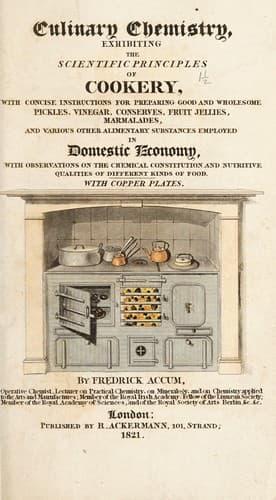
Culinary Chemistry: The Scientific Principles of Cookery, with Concise Instructions for Preparing Good and Wholesome Pickles, Vinegar, Conserves, Fruit Jellies, Marmalades, and Various Other Alimentary Substances Employed in Domestic Economy, with Observations on the Chemical Constitution and Nutritive Qualities of Different Kinds of Food.Accum, Friedrich Christian
Science
Culinary Chemistry: The Scientific Principles of Cookery, with Concise Instructions for Preparing Good and Wholesome Pickles, Vinegar, Conserves, Fruit Jellies, Marmalades, and Various Other Alimentary Substances Employed in Domestic Economy, with Observations on the Chemical Constitution and Nutritive Qualities of Different Kinds of Food.
Accum, Friedrich Christian
Cooking; Food poisoning
The drying of salt meat is effected either by hanging it in a dry and
well-aired place, or by exposing it at the same time to wood smoke,
which gives it a peculiar flavour, much admired in Westphalia hams and
Hamburgh beef, and also tends to preserve it, by the antiseptic action
of the pyrolignic acid. When meat is to be hung, it need not be so
highly salted.
The method of preparing bacon is peculiar to certain districts. The
following is the method of making bacon in Hampshire and
Somersetshire:--
The season for killing hogs for bacon is between October and March. The
articles to be salted are sprinkled over with bay-salt, and put for
twenty-four hours in the salting trough, to allow the adhering blood to
drain away. After this they take them out, wipe them very dry, and throw
away the draining. They then take some fresh bay-salt, and heating it
well in a frying-pan, rub the meat very well with it, repeating this
every day for four days, turning the sides every other day.
If the hog be very large, they keep the sides in brine, turning them
occasionally for three weeks; after which they take them out, and let
them be thoroughly dried in the usual manner.
SMOKE-DRYING, OR CURING OF BACON, HAMS, AND BEEF, AS PRACTISED IN
WESTPHALIA.
The custom of fumigating hams with wood smoke is of a very ancient date,
it was well known to the Romans, and Horace mentions it.[32]
“_Fumosæ cum pede pernæ._”
[32] Sat. II. 2-117.
Several places on the Continent are famous for the delicacy and flavour
of their hams; Westphalia, however, is at the head of the list.
The method of curing bacon and hams in Westphalia (in Germany) is as
follows: Families that kill one or more hogs a year, which is a common
practice in private houses, have a closet in the garret, joining to the
chimney, made tight, to retain smoke, in which they hang their hams and
bacon to dry; and out of the effect of the fire, that they may be
gradually dried by the wood smoke, and not by heat.
The smoke of the fuel is conveyed into the closet by a hole in the
chimney, near the floor, and a place is made for an iron stopper to be
thrust into the funnel of the chimney, to force the smoke through the
hole into the closet. The smoke is carried off again by another hole in
the funnel of the chimney, above the said stopper, almost at the
ceiling, where it escapes. The upper hole must not be too big, because
the closet must be always full of smoke, and that from wood fires. Or
the bacon and hams are simply placed in the vicinity of an open
fire-place, where wood is burned, so as to be exposed to the smoke of
the wood.
METHOD OF CURING HAMS, BEEF, AND FISH, BY MEANS OF PYRO-LIGNEOUS ACID.
The following account of the preservative quality of pyro-ligneous[33]
acid, exhibited in a memoir by Dr. Wilkinson to the Bath Society, is
highly important:--
[33] Philosophical Magazine, 1821, No. 273, p. 12.
Public-domain text, read in full here on John Shaqi.
Reviews
Reviews
No reviews yet
Be the first to share your thoughts on this work.
Elsewhere in the archive
Join the Discussion
Join the discussion
Sign in to leave a comment or review.
Sign InorCreate an account