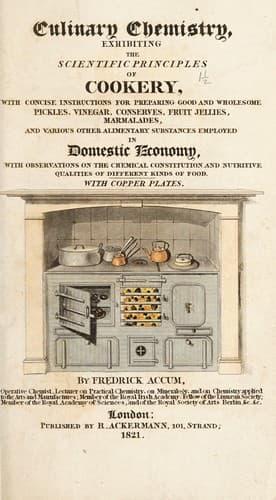
Culinary Chemistry: The Scientific Principles of Cookery, with Concise Instructions for Preparing Good and Wholesome Pickles, Vinegar, Conserves, Fruit Jellies, Marmalades, and Various Other Alimentary Substances Employed in Domestic Economy, with Observations on the Chemical Constitution and Nutritive Qualities of Different Kinds of Food.Accum, Friedrich Christian
Science
Culinary Chemistry: The Scientific Principles of Cookery, with Concise Instructions for Preparing Good and Wholesome Pickles, Vinegar, Conserves, Fruit Jellies, Marmalades, and Various Other Alimentary Substances Employed in Domestic Economy, with Observations on the Chemical Constitution and Nutritive Qualities of Different Kinds of Food.
Accum, Friedrich Christian
Cooking; Food poisoning
“Mr. Sockett having directed his attention to the smoking of hams with
wood smoke, either in a building erected for that purpose, or in a
chimney where wood alone is burned, in addition to its considerable
increase of flavour, he considered it more effectually preserved from
putrefaction by being, what is commonly called, smoke-dried. Mr. Sockett
having ascertained by experiments, that meat thus cured required less
salt, he was induced to suppose some antiseptic quality in the same,
and not attributable to the mere application of heat. A neighbouring
manufactory of pyro-ligneous acid afforded him an opportunity of trying
a variety of experiments, which convinced him of the correctness of the
supposition of the antiseptic quality of wood smoke, as the same effects
as to flavour and preservation were produced in a superior degree
without the aid of any increase of temperature, which, by drying,
diminishes the nutritious quality of meat thus exposed.”
“Mr. Sockett ascertained, that if a ham had the reduced quantity of salt
usually employed for smoke-dried hams, and was then exposed to smoke,
putrefaction soon took place when pyro-ligneous acid was not used; even
one half this reduced portion of salt is sufficient when it is used,
being applied cold, and the ham is thus effectually cured without any
loss of weight, and retaining more animal juices.”
“The mode adopted was by adding about two table-spoonfuls of
pyro-ligneous acid to the pickle for a ham of 10 or 12 lbs.; and when
taken out of the pickle, previous to being hung up, painted over with
the acid, by means of a brush. In many instances, Mr. Sockett has
succeeded by brushing the ham over with the acid, without adding any to
the pickle. The same mode answers equally well with tongues, requiring a
little more acid, on account of the thickness and hardness of the
integuments.”
“Upon dried salmon it answers admirably; brushing it over once or twice
had a better effect than two months smoking in the usual way, and
without the same loss from rancidity. From the result of a few
experiments on herrings, he is persuaded that this mode of curing might
be most advantageously introduced in our fisheries, so that herrings
might be cured here superior to those imported from Holland.”
“These experiments so satisfactorily demonstrating the antiseptic
qualities of this acid, where only small portions of salt were employed,
Mr. Sockett was then induced to try the results of the application of
this acid when no salt was employed: he placed some beef steaks upon a
plate, and covered the bottom with the acid, the steaks being daily
turned; and at the time of recording the experiment, he noticed that
they kept above six weeks without the least tendency to putrefaction:
this experiment was made in the middle of July 1815.”
“Not only Mr. Sockett, but many families in Swansea, and its vicinity,
practise, with the greatest success, this mode of curing hams, tongues,
beef, fish, &c.”
Public-domain text, read in full here on John Shaqi.
Reviews
Reviews
No reviews yet
Be the first to share your thoughts on this work.
Elsewhere in the archive
Join the Discussion
Join the discussion
Sign in to leave a comment or review.
Sign InorCreate an account