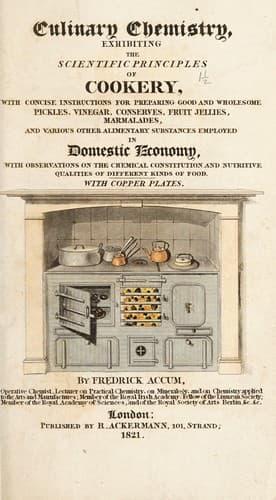
Culinary Chemistry: The Scientific Principles of Cookery, with Concise Instructions for Preparing Good and Wholesome Pickles, Vinegar, Conserves, Fruit Jellies, Marmalades, and Various Other Alimentary Substances Employed in Domestic Economy, with Observations on the Chemical Constitution and Nutritive Qualities of Different Kinds of Food.Accum, Friedrich Christian
Science
Culinary Chemistry: The Scientific Principles of Cookery, with Concise Instructions for Preparing Good and Wholesome Pickles, Vinegar, Conserves, Fruit Jellies, Marmalades, and Various Other Alimentary Substances Employed in Domestic Economy, with Observations on the Chemical Constitution and Nutritive Qualities of Different Kinds of Food.
Accum, Friedrich Christian
Cooking; Food poisoning
All kinds of animal food may be preserved in this way--beef, mutton,
veal, and poultry, either boiled or roasted. The testimonies in favour
of the success of the process are of the most unexceptionable kind. At
Messrs. Donkin and Gamble’s establishment the meat is put up in
canisters of from 4 lbs. to 20 lbs. weight each. It is charged from 1s.
8d. to 3s. a pound; roast higher than boiled, and veal dearer than
mutton or beef. The weight of the canister is deducted, and nothing is
charged for the canisters; and it should be observed, that these
provisions being cooked, and without bone, render them equivalent to
double the weight of meat in the raw state; for it is certain, that the
waste in cooking, together with the weight of bone, are about one half.
Captain Neish took a quantity of provision, thus prepared, to India, not
one canister spoiled; and one which he brought home contained beef in
the highest state of preservation after two years, and having been
carried upwards of 35,000 miles in the warmest climates.
The commissioners for victualling the navy also examined some, nearly
four years old, which had been in the Mediterranean and Quebec, and
found it as sound, sweet, and fresh, as if it had been only yesterday
boiled. We are enabled to add the testimony of that distinguished
navigator, captain Basil Hall, who has liberally communicated to us the
result of his personal experience and observation, which is as
follows:--“I can answer for the perfect preservation of a great number
of cases which were in my possession during the voyage to China. I had
88_l._ worth, and not one failure. At that time milk was preserved in
bottles corked; but tin cases have been substituted with very great
effect, as I have myself tried. It is really astonishing how excellent
the milk is; and, indeed, every thing preserved in this way is good.”
“You must, on examining the list of prices, bear in mind, that meat thus
preserved _eats_ nothing, nor _drinks_--is not apt to get the rot, or to
die--does not _tumble_ over-board, nor get its legs broken, or its flesh
wore off its bones, by knocking about the decks of a ship in bad
weather--it takes no care in the keeping--it is always ready--may be eat
cold or hot--and thus enables you to toss into a boat in a minute, as
many days’ _cooked_ provisions as you choose--it is not exposed to the
vicissitudes of markets, nor is it scourged up to a monstrous price (as
at St. Helena), because there is no alternative. Besides these
advantages, it enables one to indulge in a number of luxuries, which no
care or expence _could_ procure.”
Public-domain text, read in full here on John Shaqi.
Reviews
Reviews
No reviews yet
Be the first to share your thoughts on this work.
Elsewhere in the archive
Join the Discussion
Join the discussion
Sign in to leave a comment or review.
Sign InorCreate an account