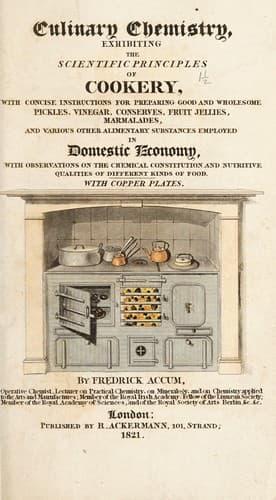
Culinary Chemistry: The Scientific Principles of Cookery, with Concise Instructions for Preparing Good and Wholesome Pickles, Vinegar, Conserves, Fruit Jellies, Marmalades, and Various Other Alimentary Substances Employed in Domestic Economy, with Observations on the Chemical Constitution and Nutritive Qualities of Different Kinds of Food.Accum, Friedrich Christian
Science
Culinary Chemistry: The Scientific Principles of Cookery, with Concise Instructions for Preparing Good and Wholesome Pickles, Vinegar, Conserves, Fruit Jellies, Marmalades, and Various Other Alimentary Substances Employed in Domestic Economy, with Observations on the Chemical Constitution and Nutritive Qualities of Different Kinds of Food.
Accum, Friedrich Christian
Cooking; Food poisoning
In this preservative process is displayed a singular and important fact
with regard to the agency of oxygen in putrefaction. The tin canisters
being closed during the exposure to heat, must necessarily contain with
the included matter some portion of air; and if heat were not applied,
or even if applied imperfectly, putrefaction would take place. This
proves that the effect of the high temperature is to produce some kind
of combination of the oxygen of the air with the animal or included
matter, not leading to putrefaction, or even counter-acting it, while
by this combination it is effectually removed. The air accordingly,
where the process is successful, is deprived of oxygen; but if the heat
were not sufficiently prolonged, and by far the greatest part of the air
in the vessel not exhausted, putrefaction soon comes on. From
experiments that have been made on this mode of preserving alimentary
substances, it has been proved, that if the vessels were opened only for
a short time and again closed, without heat being applied, the inclosed
substances soon putrefied: as they did also from mere exposure to the
air. But if, after having been exposed even for an hour or two, they
were re-placed, the vessels again treated as before, and then the due
degree of heat applied, they could be preserved as at first. And this
repeated exposure to the air, and removal of its operation by heating,
it appears from Gay Lussac’s experiments, can be renewed a number of
times. Nay, by occasional exposure to the heat of boiling water, without
the exclusion of the air, he found the exemption from putrefaction to be
attained.
The theory of these effects is not very apparent. Gay Lussac supposes,
that the oxygen may combine with that principle analogous to gluten,
which excites fermentation, and which may equally excite putrefaction;
that this by a kind of coagulation is separated by heat, and thus
rendered inert; and that it is only that part of it which has suffered
oxygenation which is capable of this coagulation; it is thus removed,
while the exclusion of oxygen prevents the putrefaction from taking
place, which would otherwise be excited by the remainder. But this is
rather hypothetical and unsatisfactory.
PRESERVATION OF MEAT BY POTTING.
The process of potting consists in reducing cooked animal substances to
a pulp, by beating the meat in a mortar, and incorporating the mass with
a portion of salt and spices. The pulp is then put into a jar, and
covered with a thick coat of melted butter or lard, to prevent the
contact of air; and the surface is further protected with a bladder-skin
tied over the mouth of the jar. The muscular part of meat is best suited
for potting, and the quantity of salt and spices ought to be rather
liberal.
POTTED BEEF, GAME, OR POULTRY.
Public-domain text, read in full here on John Shaqi.
Reviews
Reviews
No reviews yet
Be the first to share your thoughts on this work.
Elsewhere in the archive
Join the Discussion
Join the discussion
Sign in to leave a comment or review.
Sign InorCreate an account