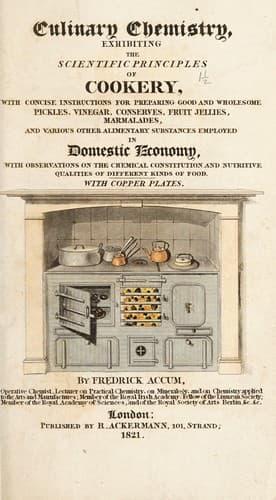
Culinary Chemistry: The Scientific Principles of Cookery, with Concise Instructions for Preparing Good and Wholesome Pickles, Vinegar, Conserves, Fruit Jellies, Marmalades, and Various Other Alimentary Substances Employed in Domestic Economy, with Observations on the Chemical Constitution and Nutritive Qualities of Different Kinds of Food.Accum, Friedrich Christian
Science
Culinary Chemistry: The Scientific Principles of Cookery, with Concise Instructions for Preparing Good and Wholesome Pickles, Vinegar, Conserves, Fruit Jellies, Marmalades, and Various Other Alimentary Substances Employed in Domestic Economy, with Observations on the Chemical Constitution and Nutritive Qualities of Different Kinds of Food.
Accum, Friedrich Christian
Cooking; Food poisoning
Mash the currants in a bowl or marble mortar, so as to break all the
berries without materially bruising the seeds; put the mass into a
saucepan, and heat it nearly to the boiling point; then rub it through a
sieve to separate the seeds. To one pint measure of the pulpy juice, add
one pound and a half of loaf sugar, let the mixture simmer gently over
the fire, and keep stirring it to prevent it burning at the bottom of
the pan. Continue the simmering till the mass, when cold, assumes the
consistence of a stiff, or almost solid paste, which may be readily
known by placing from time to time a tea spoonful of it on a cold plate.
When the mass has acquired the proper consistence, pour it out on a
marble slab, or earthenware plate, and continue the further exsiccation
by putting it in a stove, or on a hot hearth.
APRICOT PASTE,
Peach Paste
Plum Paste
Cherry Paste
Quince Paste.
Take ripe apricots, boil them till quite soft, mash them, and rub the
mass through a splinter sieve, put the pulp into a pan, and to every
pound put half a pound of powdered loaf sugar; put it again on the fire
to simmer till the paste drops off easily from the spoon, then take it
from the fire and pour it on a slab.
Peach, quince, plum, and cherry paste, may be prepared in the same
manner.
RASPBERRY PASTE.
Mash the raspberries, and having heated the mass in a saucepan, pass it
through a splinter sieve; simmer the mass gently to the consistence of a
paste, and to every pound and a quarter of the pulp, add one pound and a
half of powdered loaf sugar, and proceed as before directed.--_See black
currant paste._
ORANGE AND LEMON PASTE.
Squeeze out the juice of Seville oranges, and boil the rinds in water
till they are tender enough to be crushed between the finger; scoop out
the pulp of the fruit, and put it aside; pound the rind, in a mortar, to
form a smooth mass, pass it through a splinter sieve; add to it the
juice, and keep it on the fire till the mass acquires the consistence
of a paste; then take it off, weigh it, and to every pound and a quarter
add two pounds of powdered loaf sugar; mix and finish it like black
currant paste. _See page 260._
Lemon paste is made in a like manner.
RASPBERRY JAM.
Strawberry Jam
Currant Jam
Gooseberry Jam
Mulberry Jam.
Having mashed the raspberries, put them into a saucepan, and make them
boiling hot; rub the pulp through a coarse splinter sieve, and to a
pint, by measure, add one pound of powdered loaf sugar; simmer the
mixture with a gentle heat till the mass has acquired the consistence of
a stiff paste, and comes off from the bottom of the pan, taking care to
stir the mixture continually with a wooden spatula when it begins to
thicken. Put the jam into pots, which should be perfectly dry, for the
least damp spoils it. When quite cold, tie it over.
Strawberry, currant, gooseberry, and mulberry jam, may be prepared in a
like manner.
APRICOT JAM.
Public-domain text, read in full here on John Shaqi.
Reviews
Reviews
No reviews yet
Be the first to share your thoughts on this work.
Elsewhere in the archive
Join the Discussion
Join the discussion
Sign in to leave a comment or review.
Sign InorCreate an account