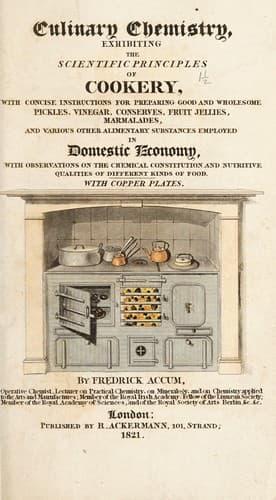
Culinary Chemistry: The Scientific Principles of Cookery, with Concise Instructions for Preparing Good and Wholesome Pickles, Vinegar, Conserves, Fruit Jellies, Marmalades, and Various Other Alimentary Substances Employed in Domestic Economy, with Observations on the Chemical Constitution and Nutritive Qualities of Different Kinds of Food.Accum, Friedrich Christian
Science
Culinary Chemistry: The Scientific Principles of Cookery, with Concise Instructions for Preparing Good and Wholesome Pickles, Vinegar, Conserves, Fruit Jellies, Marmalades, and Various Other Alimentary Substances Employed in Domestic Economy, with Observations on the Chemical Constitution and Nutritive Qualities of Different Kinds of Food.
Accum, Friedrich Christian
Cooking; Food poisoning
Take ripe apricots, cut them into pieces, and remove the stones; mash
the fruit in a marble mortar, to form it into a smooth pulp; heat it
over the fire, and when nearly boiling hot, rub it through a splinter
sieve; add to one pint, by measure, of the pulp, one pound of powdered
sugar; stir the mixture together, and suffer it to simmer over the fire
till it comes clear from the bottom of the pan, taking care to stir the
mixture all the time.
ORANGE MARMALADE.
Marmalades scarcely differ from jams. This name is applied to those
comfitures which are composed of the firmer fruits, such as quinces,
pine-apples, &c.; whereas jams are made of the more juicy, esculent
berries, such as strawberries, currants, mulberries, &c.
Cut the oranges into pieces, remove the pulp, squeeze it through a
sieve, and measure it. Boil the rind in water till it is quite soft,
then clear it from the interior side of the white pulpy mass, so that
nothing but the thin outer yellow rind is left. To every pint of the
pulpy juice add three-quarters of a pound of coarsely powdered loaf
sugar, and add also the rind of the yellow orange, cut into thin slips.
Let the whole simmer, till a sample, when taken out of the saucepan, and
suffered to cool on a plate, exhibits the consistence of a semi-fluid
mass.
PEACH MARMALADE.
Peel the peaches and take out the stones, simmer them till half done,
then drain them, reduce them to a pulp, and squeeze the mass through a
coarse splinter sieve. Weigh the pulp, and to every pound add twelve
ounces of powdered loaf sugar; simmer the mass till it has acquired a
stiff pasty consistence.
PINE APPLE MARMALADE.
Cut the fruit into small pieces, pound it in a mortar, and pass the mass
through a coarse splinter sieve; weigh the pulp, and add to every pound
three-quarters of a pound of powdered loaf sugar, and six ounces of
water, and simmer it as before described.
APRICOT MARMALADE.
Boil ripe apricots in water till they can be crushed between the
fingers, then take them out, extract the stones, reduce the fruit to a
pulp, and pass the mass through a sieve; weigh the pulp, and to every
pound take three-quarters of a pound of loaf sugar; simmer it till it
hangs on the spoon, like a stiff jelly. Quince marmalade may be prepared
in a like manner.
FRUIT JELLIES
Are compounds of the juices of fruits combined with sugar, concentrated
by boiling to such a consistence, that the liquid, upon cooling, assumes
the form of a tremulous glue.
In the preparation of jellies, care must be taken not to boil it too
long, as it looses by this means the property of gelatinising, and
assumes the form of mucilage, the danger of this is greatest when the
quantity of sugar is too small to absorb the water of the juice.
Fruit jellies should not be kept in glazed earthenware pots, because
they act, or dissolve a portion of the glaze. They should (and all other
comfitures) be covered with paper dipped in brandy, and the pots should
be tied over with paper.
Public-domain text, read in full here on John Shaqi.
Reviews
Reviews
No reviews yet
Be the first to share your thoughts on this work.
Elsewhere in the archive
Join the Discussion
Join the discussion
Sign in to leave a comment or review.
Sign InorCreate an account