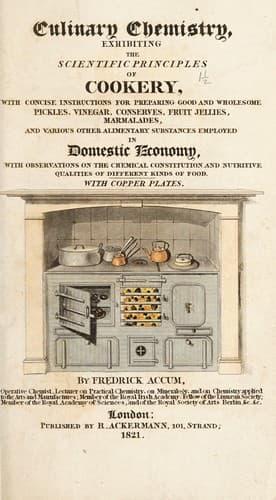
Culinary Chemistry: The Scientific Principles of Cookery, with Concise Instructions for Preparing Good and Wholesome Pickles, Vinegar, Conserves, Fruit Jellies, Marmalades, and Various Other Alimentary Substances Employed in Domestic Economy, with Observations on the Chemical Constitution and Nutritive Qualities of Different Kinds of Food.Accum, Friedrich Christian
Science
Culinary Chemistry: The Scientific Principles of Cookery, with Concise Instructions for Preparing Good and Wholesome Pickles, Vinegar, Conserves, Fruit Jellies, Marmalades, and Various Other Alimentary Substances Employed in Domestic Economy, with Observations on the Chemical Constitution and Nutritive Qualities of Different Kinds of Food.
Accum, Friedrich Christian
Cooking; Food poisoning
CURRANT JELLY.
Mash the currants, and pass them through a splinter sieve, put the pulp
on the fire, stir it with a spoon till it begins to boil, then strain
the mass through a flannel bag to render the juice clear; measure it,
and to a pint put one pound and a half of loaf sugar, and let it simmer
very gently, till you see, by dipping a spoon or skimmer in the jelly,
and again raising it, the jelly forms a web upon it, which, if simmered
enough, will remain on the skimmer. Then take it off the fire, let it
stand a few minutes till the scum has collected on the surface, remove
it and put the clear fluid into pots. When quite cold, cut pieces of
writing paper to the size of the brim of the pots, steep the paper in
brandy and place it on the jelly.
RASPBERRY JELLY.
The juice of this fruit does not gelatinize readily on account of the
quantity of mucilage which it contains; hence, for preparing a jelly by
means of this fruit, it is necessary to add to one part of raspberries
at least two parts of red or white currant juice. The jelly may then be
obtained by following the directions stated for making currant jelly.
BARBERRY JELLY.
Pick the barberries from the stalks, mash them, and having heated the
mass in a saucepan throw it into a flannel bag, to strain off the juice.
To one pint of the clear juice add one pound and a half of loaf sugar,
simmer it with a gentle heat till it gelatinizes.
GOOSEBERRY JELLY.
Take two quarts of bruised gooseberries, simmer the mass with one pint
and a half of water for about a quarter of an hour, then put it into a
flannel bag to strain off the juice, and to one pint add one pound and a
half of lump sugar; simmer it, as stated under the article currant
jelly.
APPLE JELLY.
Pare four pounds of russettins or any other sub-acid apples, cut them
into small pieces, and boil them in two quarts of water, till they
become quite soft, then put them into a sieve, strain off the liquid,
and run it through a flannel bag to render it clear; measure it, and to
one pint of the liquid add one pound and a half of sugar, and finish
the jelly as before directed. _See Currant Jelly._
QUINCE AND APRICOT JELLY
May be prepared in a similar manner.
FRUIT SYRUPS.
A weak syrup has a tendency to ferment and quickly become sour if kept
in a temperate degree of heat; it is therefore not calculated to prevent
the natural fermentation of vegetable juices, which always increase its
tendency to corrupt. Pharmaceutists have ascertained that a solution,
prepared by dissolving two parts of double refined sugar in one of
water, or any watery fluid, and boiling the solution a little, forms a
syrup, which neither ferments nor crystallizes; and this proportion may
be considered as the basis of all syrups, and seems to be the degree of
boiling syrup called _smooth_ by the confectioners.
Public-domain text, read in full here on John Shaqi.
Reviews
Reviews
No reviews yet
Be the first to share your thoughts on this work.
Elsewhere in the archive
Join the Discussion
Join the discussion
Sign in to leave a comment or review.
Sign InorCreate an account