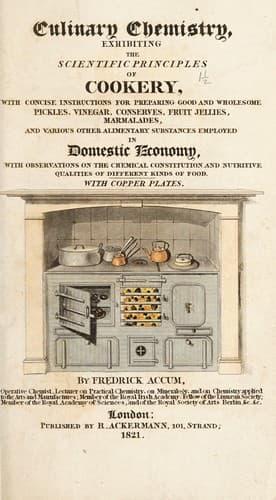
Culinary Chemistry: The Scientific Principles of Cookery, with Concise Instructions for Preparing Good and Wholesome Pickles, Vinegar, Conserves, Fruit Jellies, Marmalades, and Various Other Alimentary Substances Employed in Domestic Economy, with Observations on the Chemical Constitution and Nutritive Qualities of Different Kinds of Food.Accum, Friedrich Christian
Science
Culinary Chemistry: The Scientific Principles of Cookery, with Concise Instructions for Preparing Good and Wholesome Pickles, Vinegar, Conserves, Fruit Jellies, Marmalades, and Various Other Alimentary Substances Employed in Domestic Economy, with Observations on the Chemical Constitution and Nutritive Qualities of Different Kinds of Food.
Accum, Friedrich Christian
Cooking; Food poisoning
To make vinegar for domestic use, fit for keeping, it is essential that
the fluid employed for that purpose should contain in every gallon at
least three pounds of sugar; to allow some access of air to the vessel
in which it is kept, and to keep it in a temperature rather higher than
that of the atmosphere in this climate, that is about 75° to 80° Fahr.
It is also essential, where a liquor already fermented is employed, to
add a portion of yeast; for though any fermented liquor, if kept in a
moderate temperature in an open vessel, will spontaneously run sour, or
become changed to vinegar, this change is too gradual to produce this
acid in perfection, and the first acetified portion turns mouldy before
the last has become sour: but where the substance employed has not yet
undergone fermentation, the whole process of the vinous and subsequent
acetous fermentation will go on uninterruptedly with the same ferment
which at first set it in action, which happens, for example, in the
making vinegar from malt, or from fruit, sugar, and water.
METHOD OF MAKING GOOSEBERRY VINEGAR.
Take gooseberries, when full ripe, mash them in a tub or marble mortar,
and to every quart of the mashed fruit, put three quarts of water, stir
the pulp well together, let it stand 24 hours, and press it through a
coarse bag. To every gallon of the strained liquor add four pounds of
brown sugar, or four pounds and a half of honey, the latter is
preferable; put the mixture into a barrel, which it should fill about
three fourths, and add to eight or nine gallons of it one pint of good
ale yeast; cover the bung hole of the cask with a slate, to exclude
dust, and place the barrel in the sun in summer, or a little away from
a fire in winter. The mixture will soon begin to ferment; keep up the
fermentation by keeping the liquor at the same temperature, till the
taste and odour indicate that the vinegar is complete. When the liquor
has become perfectly clear, draw it off into bottles. It will keep much
better if it be heated nearly to the boiling point, which is best
accomplished by putting the bottles containing it in a saucepan with
water, and causing the water to boil for about one quarter of an hour.
When this has been done, remove the bottles, and when quite cold cork
them. Earthenware bottles are much less liable to crack, during this
process, than glass bottles.
RASPBERRY VINEGAR.
Take a pound of fine gathered red raspberries, mash them in a wooden
bowl, or earthenware pan, add to the pulp a pint and a half of vinegar;
make the mixture boiling hot, and strain it through a flannel bag. To
every pint of liquor add a pound of lump sugar, suffer it to simmer in
an earthen pipkin for about five minutes, and remove the scum as it
rises. When cold put it into dry bottles.
Public-domain text, read in full here on John Shaqi.
Reviews
Reviews
No reviews yet
Be the first to share your thoughts on this work.
Elsewhere in the archive
Join the Discussion
Join the discussion
Sign in to leave a comment or review.
Sign InorCreate an account