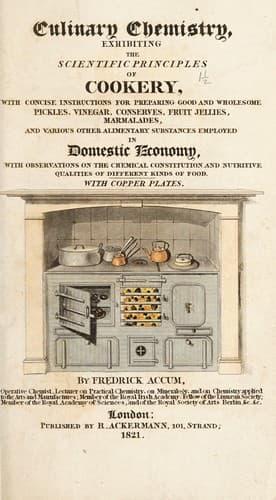
Culinary Chemistry: The Scientific Principles of Cookery, with Concise Instructions for Preparing Good and Wholesome Pickles, Vinegar, Conserves, Fruit Jellies, Marmalades, and Various Other Alimentary Substances Employed in Domestic Economy, with Observations on the Chemical Constitution and Nutritive Qualities of Different Kinds of Food.Accum, Friedrich Christian
Science
Culinary Chemistry: The Scientific Principles of Cookery, with Concise Instructions for Preparing Good and Wholesome Pickles, Vinegar, Conserves, Fruit Jellies, Marmalades, and Various Other Alimentary Substances Employed in Domestic Economy, with Observations on the Chemical Constitution and Nutritive Qualities of Different Kinds of Food.
Accum, Friedrich Christian
Cooking; Food poisoning
Or, better mash the raspberries, suffer them to ferment till the juice
separates from the pulpy matter; then add to a pint of the mass a pint
and a half of vinegar, let it simmer for a few minutes, and strain it
through a flannel.
CHILLI VINEGAR.
Tarragon Vinegar
Mint Vinegar
Eschallot Vinegar
Burnet Vinegar
Put an ounce of red chillies, (capsicum) cut into small pieces, into a
bottle containing a pint of vinegar, stop the bottle close, and suffer
the chillies to macerate for eight or ten days, and then strain off the
clear infusion. Tarragon, mint, or burnet vinegar may be made in a
similar way, by suffering four ounces of fresh gathered tarragon, mint,
or burnet, (or three ounces) eschallots, to macerate for eight or ten
days in a quart of vinegar.
Tea.
The dried leaves of the tea plant, a commodity with which we are so well
acquainted, and which affords a beverage so generally used in this
country, must excite curiosity to know something of its natural history,
or the nature of the plant from which it is obtained.
The precise period when tea was first made known in Europe cannot be
ascertained; it is said that some Dutch adventurers, seeking for such
objects as might fetch a high price in China, and hearing of the general
use there of a beverage from a plant of that country, made them fall
upon the idea of trying whether not an European plant might be relished
by the Chinese, and become an article of commerce among them, and
accordingly they introduced to them the herb _Sage_, the adventurers
accepting in return the Chinese tea, which they brought to Europe. The
European herb did not continue long in use in China, but the consumption
of tea has been amazingly increasing in Europe ever since. It is
generally said, that it was first imported from Holland into England,
about 1666, by lord Arlington and lord Ossory, who brought it into
fashion among people of quality. But it was used in coffee-houses before
this period, as it appears by an act of parliament made in 1660, in
which a duty of 8_d._ was laid on every gallon of the infusion sold in
these places. In 1666 it was sold in London for 60_s._ per pound, though
it did not cost more than 2_s._ 6_d._ or 3_s._ 6_d._ at Batavia. It
continued at this price till 1700. In 1715 green tea began to be used;
and as great quantities were then imported, the price was lessened, and
the practice of drinking tea descended to the lower ranks. In 1720, the
French began to send tea to us by a clandestine commerce. Since that
period the demand has been increasing yearly, and it has become almost a
necessary of life in several parts of Europe, even among the lowest as
well as the highest ranks.
NATURAL HISTORY OF THE TEA TREE.
Public-domain text, read in full here on John Shaqi.
Reviews
Reviews
No reviews yet
Be the first to share your thoughts on this work.
Elsewhere in the archive
Join the Discussion
Join the discussion
Sign in to leave a comment or review.
Sign InorCreate an account