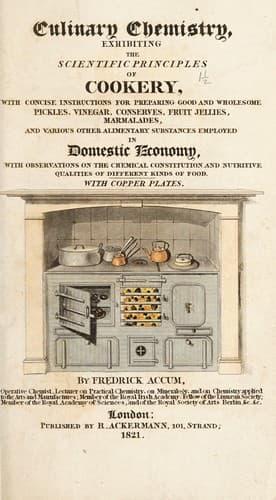
Culinary Chemistry: The Scientific Principles of Cookery, with Concise Instructions for Preparing Good and Wholesome Pickles, Vinegar, Conserves, Fruit Jellies, Marmalades, and Various Other Alimentary Substances Employed in Domestic Economy, with Observations on the Chemical Constitution and Nutritive Qualities of Different Kinds of Food.Accum, Friedrich Christian
Science
Culinary Chemistry: The Scientific Principles of Cookery, with Concise Instructions for Preparing Good and Wholesome Pickles, Vinegar, Conserves, Fruit Jellies, Marmalades, and Various Other Alimentary Substances Employed in Domestic Economy, with Observations on the Chemical Constitution and Nutritive Qualities of Different Kinds of Food.
Accum, Friedrich Christian
Cooking; Food poisoning
It has been long observed, that the infusion of tea, made in silver or
polished metal tea-pots, is stronger than that which is produced in
black, or other kinds of earthenware pots. This remark is explained on
the principles, that polished surfaces retain heat much better than dark
rough surfaces, and that, consequently, the caloric being confined in
the former case, must act more powerfully than in the latter. It is
further certain, that the silver or metal pot, when filled a second
time, produces worse tea than the earthenware vessel; and that it is
advisable to use the earthenware pot, unless a silver or metal one can
be procured sufficiently large to contain, at once, all that may be
required. These facts are readily explained, by considering that the
action of heat, retained by the silver vessel, so far exhausts the herb,
as to leave very little soluble substance for a second infusion;
whereas, the reduced temperature of the water in the earthenware pot, by
extracting only a small portion at first, leaves some soluble matter for
the action of a subsequent infusion.
The reason for pouring boiling water into the teapot, before the
infusion of the tea is made, is, that the vessel, being previously warm,
may abstract less heat from the mixture, and thus admit a more powerful
action. Neither is it difficult to explain the fact, why the infusion of
tea is stronger if only a small quantity of boiling water be first used,
and more be added some time afterwards, for if we consider that only the
water immediately in contact with the herb can act upon it, and that it
cools very rapidly, especially in earthenware vessels, it is clear that
the effect will be greater where the heat is kept up by additions of
boiling water, than where the vessel is filled at once, and the fluid
suffered gradually to cool. When the infusion has once been completed,
it is found that any further addition of the herb only affords a very
small increase in the strength, the water having cooled much below the
boiling point, and consequently acting very slightly.
JAPANESE METHOD OF MAKING TEA.
The people of Japan reduce their tea to a fine powder, which they dilute
with warm water until it has acquired the consistence of a thin soup.
Their manner of serving tea is as follows:--They place before the
company the tea-equipage, and the caddy in which this powder is
contained; they fill the cups with warm water, and taking from the caddy
as much powder as the point of a knife can contain, throw it into each
of the cups, and stir it, until the liquor begins to foam; it is then
presented to the company, who sip it while it is warm. According to Du
Halde, this method is not peculiar to the Japanese; it is also used in
some of the provinces of China.
Coffee.
Public-domain text, read in full here on John Shaqi.
Reviews
Reviews
No reviews yet
Be the first to share your thoughts on this work.
Elsewhere in the archive
Join the Discussion
Join the discussion
Sign in to leave a comment or review.
Sign InorCreate an account