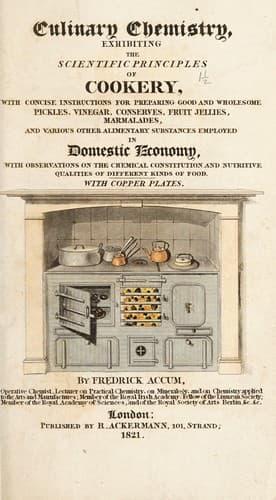
Culinary Chemistry: The Scientific Principles of Cookery, with Concise Instructions for Preparing Good and Wholesome Pickles, Vinegar, Conserves, Fruit Jellies, Marmalades, and Various Other Alimentary Substances Employed in Domestic Economy, with Observations on the Chemical Constitution and Nutritive Qualities of Different Kinds of Food.Accum, Friedrich Christian
Science
Culinary Chemistry: The Scientific Principles of Cookery, with Concise Instructions for Preparing Good and Wholesome Pickles, Vinegar, Conserves, Fruit Jellies, Marmalades, and Various Other Alimentary Substances Employed in Domestic Economy, with Observations on the Chemical Constitution and Nutritive Qualities of Different Kinds of Food.
Accum, Friedrich Christian
Cooking; Food poisoning
The beverage which we call coffee, is said to have been drank in
Ethiopia from time immemorial. The Galla, a wandering nation of Africa,
in their excursions on Abyssinia, being obliged to traverse immense
deserts, and being also desirous of falling on the Abyssinians, without
warning, that they may be incumbered as little as possible with baggage,
carry nothing with them to eat, but coffee roasted, till it can be
pulverised, and then mixed with butter into balls; one of these, about
the size of a billiard ball, is said to keep them during a whole day’s
fatigue.[39]
[39] Bruce’s Abyss. II. 226.
The liquor, called coffee, was introduced into Adea, in Arabia, from
Persia, about the middle of the 15th century. Not long after it reached
Mecca, Medina, &c. and Grand Cairo. Hence it continued its progress to
Damascus and Aleppo, and in 1554 became known at Constantinople.
It is not certain at what time the use of coffee passed from
Constantinople to the Western part of Europe. Thevenot, a French
traveller into the East, at his return in 1657, brought with him coffee
to Paris. In the year 1671, a coffee-house was opened at Marseilles.
Soon after coffee-rooms were opened at Paris.
The first mention of coffee in our statute books was 1660. In the year
1688, Mr. Ray affirms, that London might rival Grand Cairo in the number
of its coffee-houses.[40]
[40] Miller’s Gardener’s Dictionary.
NATURAL HISTORY OF THE COFFEE TREE.
The tree which produces coffee contains ten species, chiefly natives of
the East Indies, South America, and the Polynesian isles. The only
species, however, that we have to notice in the present work is the
coffee Arabica, of which there are two varieties, though both are sold
in our shops as Turkey coffee, and possess similar qualities.
The tree seldom rises more than 16 or 18 feet high, with an erect main
stem, covered with a lightish brown bark: the leaves are oblong-ovate,
and pointed; the flowers are set in clusters; they are of a pure white,
and possess a very pleasant odour, but their duration is very transient.
The fruit resembles a cherry, and grows in clusters, ranged along the
branches under the axillæ of the leaves, which are of a laurel hue, but
rather longer than a laurel leaf. It is an ever-green, and makes a
beautiful appearance at every season in the year, but particularly when
it is in flower.
Public-domain text, read in full here on John Shaqi.
Reviews
Reviews
No reviews yet
Be the first to share your thoughts on this work.
Elsewhere in the archive
Join the Discussion
Join the discussion
Sign in to leave a comment or review.
Sign InorCreate an account