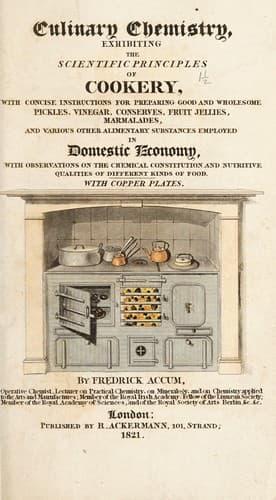
Culinary Chemistry: The Scientific Principles of Cookery, with Concise Instructions for Preparing Good and Wholesome Pickles, Vinegar, Conserves, Fruit Jellies, Marmalades, and Various Other Alimentary Substances Employed in Domestic Economy, with Observations on the Chemical Constitution and Nutritive Qualities of Different Kinds of Food.Accum, Friedrich Christian
Science
Culinary Chemistry: The Scientific Principles of Cookery, with Concise Instructions for Preparing Good and Wholesome Pickles, Vinegar, Conserves, Fruit Jellies, Marmalades, and Various Other Alimentary Substances Employed in Domestic Economy, with Observations on the Chemical Constitution and Nutritive Qualities of Different Kinds of Food.
Accum, Friedrich Christian
Cooking; Food poisoning
1 cup 1¹⁄₂ 5¹⁄₄
2 cups 2¹⁄₈ 5¹⁄₄
3 or 4 cups 2³⁄₄ 5
5 or 6 cups 3¹⁄₂ 5¹⁄₈
7 or 8 cups 4 5¹⁄₄
9 or 10 cups 4⁵⁄₈ 5¹⁄₃
11 or 12 cups 5 5¹⁄₂
Metal coffee pots should be kept as bright as possible; for, when the
external surface is kept clean and bright, the pot will be less cooled
by the surrounding cold bodies than when its metallic splendour is
impaired by neglecting to clean it; pots for making coffee in the manner
stated in the preceding pages, may now be had in most of the tinmen’s
shops of this metropolis.
Kitchen Fire-places,
AND
Cooking Utensils.
The judicious use and proper application of fuel are objects of
particular moment in domestic economy, especially in the culinary art.
Coal is an article of primary necessity among all ranks of people, and
as it cannot be procured without great expense, the consumption of it in
cookery with the smallest possible waste is an object deserving the
attention of every family. So numerous are the varieties of kitchen
fire-places which have been invented to save fuel, that there is hardly
an ironmonger in this metropolis who does not claim the merit of
possessing a patent for an apparatus of this description. The pretended
improvements of a great many patent kitchen fire-places for cooking,
unfortunately consist in increasing the quantity of iron work, to their
evident defect. The bare inspection of others again, will at once
convince the impartial observer, that they cannot answer the intended
purpose; most of them are furnished with numerous doors and apertures,
solely introduced to facilitate the cleaning of the flues; and the
reader may rest assured, that whenever recourse is had to such
expedients, it is a sure sign that the construction of the fire-place or
apparatus is extremely defective. When the combustion of the fuel is
perfect, there is little soot produced--for a rapid accumulation of it,
indicates an imperfect combustion, and consequently a waste of fuel. The
evil in the cases which we have observed, originates in the circuitous
direction and awkward angular distortions of the flues for heating the
baking closets, or the vessels for boiling. The fire grate is indeed
comparatively small in all of them, and this their apparent
recommendation is what misleads the purchaser, who on inspecting the
apparatus is told, that he will be enabled to roast, bake, boil or stew,
with a small quantity of fuel. But if we consider the mass of iron-work
requiring to be heated by the small fire-place, the saving of coals will
prove wholly imaginary, and the purchaser (we speak from experience)
will soon become convinced that the simplest and most economical
employment of fuel, for the purpose of cooking in a family not exceeding
Public-domain text, read in full here on John Shaqi.
Reviews
Reviews
No reviews yet
Be the first to share your thoughts on this work.
Elsewhere in the archive
Join the Discussion
Join the discussion
Sign in to leave a comment or review.
Sign InorCreate an account