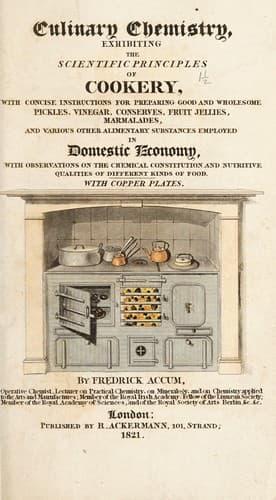
Culinary Chemistry: The Scientific Principles of Cookery, with Concise Instructions for Preparing Good and Wholesome Pickles, Vinegar, Conserves, Fruit Jellies, Marmalades, and Various Other Alimentary Substances Employed in Domestic Economy, with Observations on the Chemical Constitution and Nutritive Qualities of Different Kinds of Food.Accum, Friedrich Christian
Science
Culinary Chemistry: The Scientific Principles of Cookery, with Concise Instructions for Preparing Good and Wholesome Pickles, Vinegar, Conserves, Fruit Jellies, Marmalades, and Various Other Alimentary Substances Employed in Domestic Economy, with Observations on the Chemical Constitution and Nutritive Qualities of Different Kinds of Food.
Accum, Friedrich Christian
Cooking; Food poisoning
Formerly, the ground coffee being put into a coffee-pot, with a
sufficient quantity of water, the coffee-pot was put over the fire, and
after the water had been made to boil a certain time, the pot was
removed from the fire, and the grounds having had time to settle, or
having been fined down with isinglass, the clear liquor was poured off,
and immediately served up in cups. This was a bad practice of making
coffee.
From the results of several experiments made by Count Rumford, to
ascertain what proportion of the aromatic and volatile particles in the
coffee escape, and are left in this process, he found that it amounted
to considerably more than half.
When coffee is made in the most advantageous manner, the ground coffee
is pressed down in a cylindrical vessel _a_, (fig. 4, plate facing the
title page), which has its bottom pierced with many small holes, so as
to form a metal strainer; a proper quantity of boiling hot water being
poured cautiously on this layer of coffee in powder, the water
penetrates it by degrees, and after a certain time begins to filter
through it. This gradual percolation brings continually a succession of
fresh particles of hot water into contact with the ground coffee; and
when the last portion of the water has passed through it, every thing
capable of being dissolved by the water will be found to be so
completely washed out of it, that what remains will be of no kind of
value.
It is, however, necessary to the complete success of this operation,
that the coffee should be ground to a powder sufficiently fine. In
order that the coffee may be perfectly good, the stratum of ground
coffee, on which the boiling water is poured, must be of a certain
thickness, and it must be pressed together with a certain degree of
force, by means of the presses _b_, (fig. 4.) If it be too thin, or not
sufficiently pressed together, the water will pass through it too
rapidly; and if the layer of ground coffee be too thick, or if it be too
much pressed together, the water will be too long in passing through it,
and the taste of the coffee will be injured.
Count Rumford recommends, as of importance, that the surface of the
coffee be rendered quite level after it is put into the strainer before
any attempt is made to press it together, that the water, in
percolating, may act equally on every part.
When the coffee is made, the strainer, or cylindrical vessel _a_ is
removed, and the lid of it is made to serve as the lid for the coffee
pot.
The following table shews the diameters and heights of the cylindrical
vessels, or strainers, to be used in making the following quantities of
coffee:--
Quantity of Coffee to Diameter of Height of
be made at once. the Strainer. the Strainer.
_In Inches._ _In Inches._
Public-domain text, read in full here on John Shaqi.
Reviews
Reviews
No reviews yet
Be the first to share your thoughts on this work.
Elsewhere in the archive
Join the Discussion
Join the discussion
Sign in to leave a comment or review.
Sign InorCreate an account