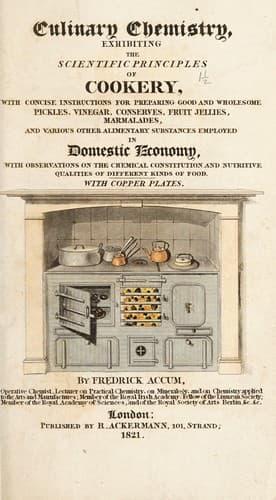
Culinary Chemistry: The Scientific Principles of Cookery, with Concise Instructions for Preparing Good and Wholesome Pickles, Vinegar, Conserves, Fruit Jellies, Marmalades, and Various Other Alimentary Substances Employed in Domestic Economy, with Observations on the Chemical Constitution and Nutritive Qualities of Different Kinds of Food.Accum, Friedrich Christian
Science
Culinary Chemistry: The Scientific Principles of Cookery, with Concise Instructions for Preparing Good and Wholesome Pickles, Vinegar, Conserves, Fruit Jellies, Marmalades, and Various Other Alimentary Substances Employed in Domestic Economy, with Observations on the Chemical Constitution and Nutritive Qualities of Different Kinds of Food.
Accum, Friedrich Christian
Cooking; Food poisoning
To economise the heat of the iron plate, a small oven is sometimes
placed at the extremity of the flue of the fire-place, which heats the
plate. It is convenient for a variety of culinary purposes requiring a
very gentle heat, or if it be wanted for baking meat, or bread, a small
fire-grate fixed underneath it, will render it extremely fit for those
purposes.
The front wall which supports the iron plate or hearth, should be
constructed of brick-work, not of iron, as the former retains the heat
very effectually, whereas the latter enables it to pass into the
kitchen, to the great annoyance of the cook.
The open fire-place, connected with this cooking hearth, is furnished at
the left hand side with a baking closet, and at the right hand side is a
steam boiler for heating the vessels _a a_. Underneath of these is
another hot closet, likewise heated by steam.
Mr. Marriott, an ingenious ironmonger in Fleet-street, has greatly
improved the construction of kitchen ranges; the design exhibited, on
the title page of this Treatise, is copied from an apparatus of his
construction.
Fig. 1, is a Dutch oven; a description of it has been given, page 88.
STEWPANS AND SAUCEPANS
Should not be made with flat bottoms, but rounded a little at the
edges--they must by no means be made with corners that are square like
tin vessels, for such can never be completely cleaned, and do not wear
near so long--that is the sides should not be soldered to the bottom
with a square joint, as sand and grease that lodge there can never be
completely got out.
These utensils should be scoured on the outside round the rim, and a
little way down the sides, but not low on the sides or on the bottom, as
that only wears them without any sort of advantage. For small families,
we recommend tin saucepans, as being lightest and safest; and if proper
care is taken of them, and they are well dried after they are cleaned,
are by far the cheapest, for the cost of a new tin saucepan is little
more than the expense of tinning a copper one. The covers of the boiling
pots should fit close, not only to prevent unnecessary evaporation of
the water, but to guard against the smoke of the fire insinuating itself
under the edge of the lid.
PRESERVING PANS.
The best sort are those which are heated by means of steam, the
temperature of which can never be such as to burn, or cause adherence to
the bottom of the pan.--Fig. 3, exhibits a steam preserving-pan; the
steam enters from a common steam-boiler, at the extremity _a_, and
passes between the pan, which is double, as shown in the design. The
condensed water may, from time to time, be drawn off by the cock and
pipe _b_.
COPPER COOKING UTENSILS.
Public-domain text, read in full here on John Shaqi.
Reviews
Reviews
No reviews yet
Be the first to share your thoughts on this work.
Elsewhere in the archive
Join the Discussion
Join the discussion
Sign in to leave a comment or review.
Sign InorCreate an account