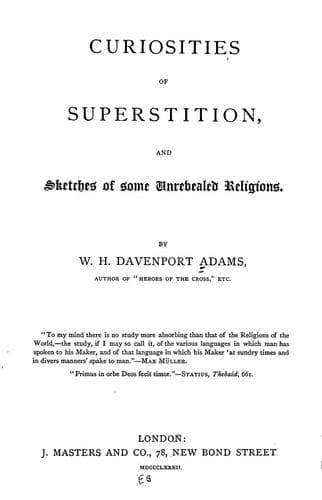
Curiosities of Superstition, and Sketches of Some Unrevealed ReligionsAdams, W. H. Davenport (William Henry Davenport)
Religion
Curiosities of Superstition, and Sketches of Some Unrevealed Religions
Adams, W. H. Davenport (William Henry Davenport)
Folklore; Religions; Superstition
Mr. Fortune remarks that a large number of Buddhist temples are scattered
over all this part of the country. Their architects have shown as keen a
sympathy with nature as the Cistercian founders in Europe, always building
them in the most lovely and picturesque situations, amongst the green
hills, and in the shelter of spreading woods--the leafy enclosures that in
England indicate the presence of an old manor house, or “ancestral hall.”
_Poo-to_, or the Worshipping Island, as foreigners call it, is one of the
eastern islands in the Chusan Archipelago, and seems to be one of the
great Buddhist centres. The principal group of temples is situated in a
fine romantic glen, and from the high ground above it, seems like a town
of considerable size. As the traveller approaches nearer, he finds the
view of great interest. In front extends a large artificial pond, filled
with the broad green leaves and noble red and white flowers of the
nelumbium speciosum,--a plant in high favour with the Chinese. Access to
the monastery is obtained by a very ornamental bridge thrown across this
piece of water.
The temples or halls containing the idols are extremely spacious; many of
the idols are thirty or forty feet high, generally made of wood or clay,
and then richly gilt. In a temple of far less pretentious character than
any of the others Mr. Fortune met with some exquisite bronze statues, of
undoubted value.
Having examined these temples, our traveller made his way towards another
group of them, about two miles to the eastward, and close on the sea
shore. Entering the courts through a kind of triumphal arch, which looked
out upon the sapphire sea, he found that these temples were constructed on
the same plan.
On the following day he inspected various parts of the island. In addition
to the larger temples just noticed, about sixty or seventy smaller ones
are built on all the hill sides, each containing three or four priests,
who are all under the abbot, or superior, residing near one of the large
temples. “Even on the top of the highest hill,” he says, “probably 1,500
or 1,800 feet above the level of the sea, we found a temple of
considerable size and in excellent repair. There are winding stone steps
from the sea-beach all the way up to this temple, and a small
resting-place about half-way up the hill, where the weary devotee may
rest and drink of the refreshing stream which flows down the sides of the
mountain, and in the little temple close at hand, which is also crowded
with idols, he can supplicate Buddha for strength to enable him to reach
the end of his journey. We were surprised to find a Buddhist temple in
such excellent order as the one on the summit of the hill proved to be in.
It is a striking fact, that almost all these places are crumbling fast
into ruins. There are a few exceptions, in cases where they happen to get
a good name amongst the people from the supposed kindness of the gods; but
the great mass are in a state of decay.”
Public-domain text, read in full here on John Shaqi.
Reviews
Reviews
No reviews yet
Be the first to share your thoughts on this work.
Elsewhere in the archive
Join the Discussion
Join the discussion
Sign in to leave a comment or review.
Sign InorCreate an account