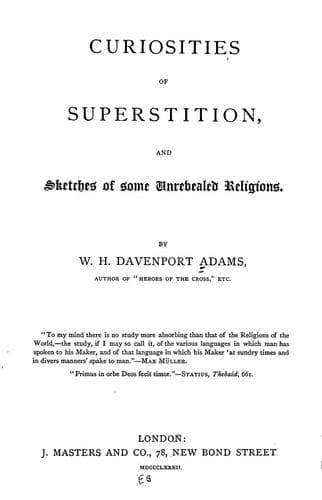
Curiosities of Superstition, and Sketches of Some Unrevealed ReligionsAdams, W. H. Davenport (William Henry Davenport)
Religion
Curiosities of Superstition, and Sketches of Some Unrevealed Religions
Adams, W. H. Davenport (William Henry Davenport)
Folklore; Religions; Superstition
The temple forms the centre of a fine landscape. It stands at the head of
a fertile valley, with green hills all around it; this valley echoes with
the music of several bright mountain streams, and yields abundant crops of
rice. On the lower slopes of the more fertile hills grow masses of tea
shrubs, with dark green leaves, lending a fine background to the picture.
A long avenue of Chinese pine trees leads up to the temple. At first it is
straight, but near the temple it winds picturesquely round the edges of
the artificial lakes, to end at a flight of stone steps. Behind, and on
each side, the mountains rise in irregular ridges, from 1,000 to 2,000
feet above the sea level; not bare and desolate like the mountains of the
south, but clothed to their tops with a dense tropical-looking growth of
brushwood, shrubs, and trees. Some of the finest bamboos of China flourish
in the ravines, and the sombre-coloured pine attains to a large size on
the acclivities.
A quaint account of the origin of the monastery was given by one of the
head priests:--
“Many hundred years ago a pious old man retired from the world, and came
to dwell in these mountains, giving himself up entirely to the performance
of religious duties. So earnest was he in his devotions that he neglected
everything relating to his temporal wants, even to his daily food.
Providence, however, would not suffer so good a man to starve. Some boys
were sent in a miraculous manner, who daily supplied him with food. In the
course of time the fame of the sage extended all over the adjacent
country, and disciples flocked to him from all quarters. A small range of
temples was built, and thus commenced the extensive buildings which now
bear the name of ‘Tien-tung,’ or the ‘Temple of the Heavenly Boys;’ _Tien_
signifying heaven, and _tung_, a boy. At last the old man died, but his
disciples supplied his place. The fame of the temple spread far and wide,
and votaries came from the most distant parts of the empire--one of the
Chinese kings being amongst the number--to worship and leave their
offerings at its altars. Larger temples were built in front of the
original ones, and these again in their turn gave way to those spacious
buildings which form the principal part of the structure of the present
day.”
Public-domain text, read in full here on John Shaqi.
Reviews
Reviews
No reviews yet
Be the first to share your thoughts on this work.
Elsewhere in the archive
Join the Discussion
Join the discussion
Sign in to leave a comment or review.
Sign InorCreate an account