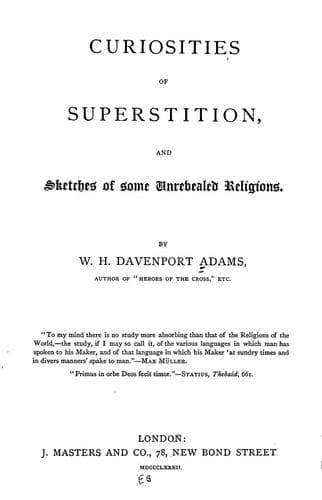
Curiosities of Superstition, and Sketches of Some Unrevealed ReligionsAdams, W. H. Davenport (William Henry Davenport)
Religion
Curiosities of Superstition, and Sketches of Some Unrevealed Religions
Adams, W. H. Davenport (William Henry Davenport)
Folklore; Religions; Superstition
Of this singular race of Malays, the Orang-Lauts, “Men of the Seas,” or
“Sea-Gipsies,” it is said that they do not seem to know anything of a
Creator. “A fact so difficult to believe,” says Mr. Thomson, “when we find
that the most degraded of the human race, in other quarters of the globe,
have an intuitive idea of this unerring and primary truth imprinted on
their minds, that I took the greatest care to find a slight image of the
Deity within the chaos of their thoughts, however degraded such might be,
but was disappointed. They knew neither the God nor the Devil of the
Christians or Mohammedans, although they confessed they had been told of
such; nor any of the demi-gods of Hindu mythology, many of whom were
recounted to them.”
The three great epochs of individual life, birth, marriage, death, pass
unnoticed by them. At birth, the mother’s joy is the only welcome to a
world it is not likely to find very bright or happy. At marriage, the sole
solemnity is the exchange between the male and the female of a mouthful of
tobacco and a cheepah, or gallon, of water. At death, the body of the
deceased is wrapped in his rags and tatters, and with, perhaps, a few
tears from the attendant women, committed to the earth. They have none of
that exquisite enjoyment of life which is felt by a cultured race; and
neither the entrance upon it nor the passage from it seems to them an
event calculated to awaken any emotion of interest. And as they are
absolutely without religion, so are they wholly free from superstition;
the solemn influences of Nature seem to produce no effect upon their
stolid dispositions. Of the pârus, and dewas, and nambangs, and other
phantom forms which, in the quick imagination of the Malay, haunt each
mountain, rock, and tree, they nothing know; and knowing nothing, they do
not fear. Terror is as often the result of knowledge as of ignorance. The
mind that has no conception of an unseen world or a supernatural force,
must necessarily be free from all apprehension of it.
* * * * *
Public-domain text, read in full here on John Shaqi.
Reviews
Reviews
No reviews yet
Be the first to share your thoughts on this work.
Elsewhere in the archive
Join the Discussion
Join the discussion
Sign in to leave a comment or review.
Sign InorCreate an account